Low-moisture encapsulation returns carpet to light foot traffic in 2 to 4 hours. Hot-water extraction is the deeper clean and takes longer, so the choice between them is usually driven by how long the space can be out of service rather than by the carpet itself.
For an office that has to open at eight, or a corridor that never truly closes, that difference decides the schedule. We will tell you which method your floor needs and what it costs you in downtime before you book anything.
Power Carpet Cleaning provides low-moisture carpet cleaning in South Florida for busy offices, hotels, condo common areas, retail spaces, and commercial properties that need faster drying across South Florida. The service is designed for properties that need a cleaner, better-looking space without guesswork or unnecessary disruption.
Every job starts with the condition of the surface, the amount of foot traffic, the stains or buildup present, and the schedule the property needs to keep. From there, we match the cleaning method to the space.
When low-moisture carpet cleaning in South Florida Helps
The building needs carpet cleaning with limited downtime
Traffic lanes need maintenance between deep cleanings
A facility manager wants a recurring carpet care plan
Humidity and access windows make drying time important
Public-facing areas need to look cleaner more consistently
How We Approach the Work
Review carpet type, soil level, humidity, and traffic patterns
Identify whether low-moisture care, hot-water extraction, or a combination is the better fit
Treat visible spots and high-use zones before cleaning
Clean in phases when the building needs to stay open
Recommend a maintenance interval for recurring traffic lanes
Low-moisture carpet cleaning is useful for occupied buildings that need faster return to use.
Commercial and Residential Options
Power Carpet Cleaning serves both commercial clients and homeowners. For businesses, that may mean service after hours, phased cleaning, common-area maintenance, or recurring floor care. For homes, it may mean focused stain treatment, rug cleaning, upholstery cleaning, or help before guests, move-ins, and move-outs.
Service Areas
Service is available across Broward, Miami-Dade, and Palm Beach County, including Fort Lauderdale, Miami, Hollywood, Pembroke Pines, Boca Raton, West Palm Beach, Delray Beach, and surrounding communities.
Encapsulation is not a gentler version of extraction. It is a different mechanism, and understanding it is what explains both the short dry time and the reason the floor keeps improving after we leave.
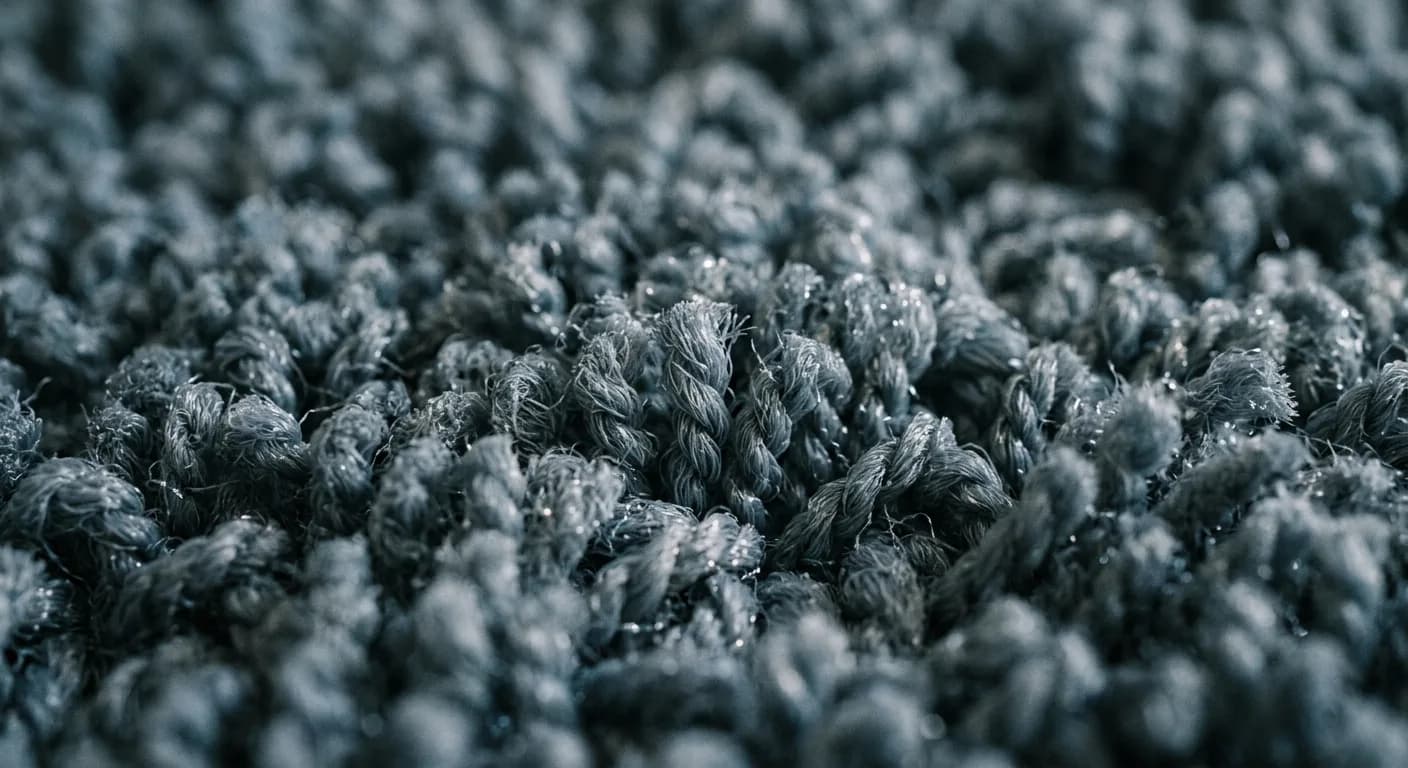
The cleaner combines surfactants with encapsulating polymers. The surfactants suspend and release soil in the ordinary way. The polymer is the part that changes the outcome: it attaches to both the soil and the fibre, and then it dries to a very hard film. Hard means brittle, and brittle means it fractures — so when the carpet is vacuumed, the dry polymer breaks away from the fibre and takes the soil with it.
The soil is not dissolved and it is not extracted. It is wrapped in something rigid and then snapped off.
The polymer we use is non-hygroscopic: it does not draw moisture out of the air. In most of the country that is a footnote. In South Florida it is the specification, because a residue that attracts moisture in a humid building never fully dries, stays slightly tacky, and collects the soil the method exists to avoid. The same property is why carpets cleaned this way most often dry in under an hour.
04Overview
The six steps we run
1. Pre-vacuum, thoroughly
Dry soil is 80 per cent of the total soil in a carpet. Adding solution to a carpet still full of it makes mud, which is the single most common reason a clean disappoints. A strong commercial vacuum is needed — one that opens tight commercial pile and pulls soil from the base rather than skimming the tips.
2. Mix
The encapsulation cleaner is mixed to the container directions into a pump-up or electric sprayer. Any water temperature works; hot water produces noticeably better results.
3. Apply as a mist
A consistent, overlapping pattern, with more solution only in heavily soiled areas. The instinct to be generous is the wrong one — over-wetting is what turns a two-hour dry time into an overnight problem.
4. Agitate
This is the only step that changes between machines. Agitation carries the chemistry down the fibre rather than leaving it sitting on the pile.
5. Let it dry, and cure
Twenty to sixty minutes to dry to the touch, depending on conditions and how much solution went down. Full cure is about 24 hours, at which point the residue has crystallised around the suspended soil.
6. Vacuum it out
The soil leaves with dry vacuuming, using high-efficiency collection and filtration so crystallised agents and suspended soils are removed rather than redistributed into the air of an occupied building. Routine vacuuming keeps lifting crystallised soil for days afterwards — which is why the building’s own vacuuming round is the last step of the method rather than something running alongside it.
05Overview
Four machines, one procedure
Put our machine procedures side by side and they are the same six steps. Exactly one differs — the agitation — which means the choice of machine is a question about the floor rather than about the chemistry.
Bonnet pad — the simplest agitation there is, and the most portable. Works the top of the pile hard and the base of it very little. Right for tight spaces, stairs and small rooms.
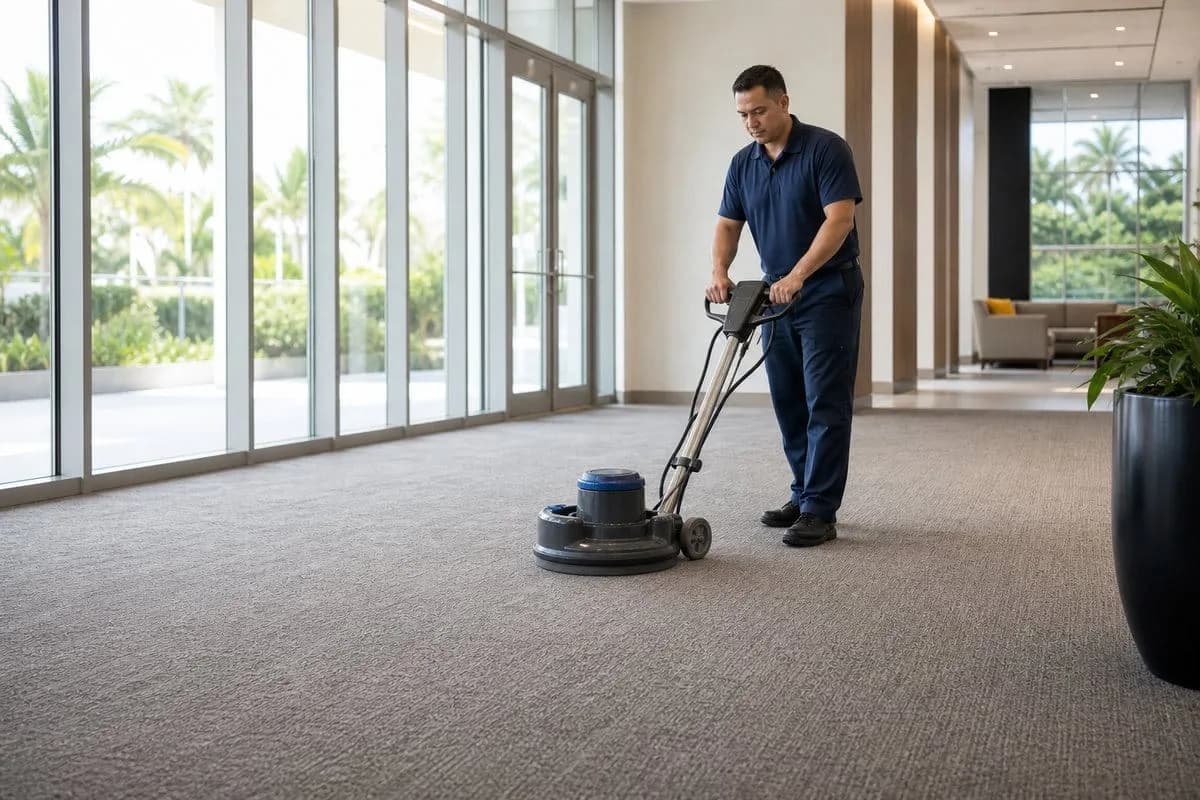
Pro Caps — the same pad principle on a dedicated machine, which buys consistency: the same pressure across a whole area rather than whatever the operator’s arms were doing by the end of a corridor.
Brush Pro — counter-rotating brushes rather than a pad. They reach deep into the pile, and with stainless renovators fitted remove considerably more dry soil than a commercial vacuum will. Right when the problem is embedded grit rather than surface appearance.
Cimex — three counter-rotating heads. The counter-rotation removes the constant slide a single-direction machine fights you with, so the machine tracks straight over long distances without wearing out the operator. Right for large open floor plates.
One thing none of them addresses: deeply embedded sand at the base of a heavily trafficked pile. That is a pile lifter’s job, done before the clean rather than instead of it — the lifter opens the pile so whatever follows can reach into it.
06Overview
When low moisture is the right answer
Low moisture is interim work. It holds appearance between restorative cleans, concentrated where traffic actually is. It does not replace restorative cleaning, and a programme running encapsulation alone will eventually need hot-water extraction to reach what low moisture cannot.
The choice between them is decided by downtime, not by preference. Establish how long an area can be out of service, then select the method that fits:
A four-hour window — interim cleaning. Back in light foot traffic in two to four hours.
An overnight closure of one section — restorative extraction of that section.
No window at all — the building is cleaned in sections, continuously, and never all at once.
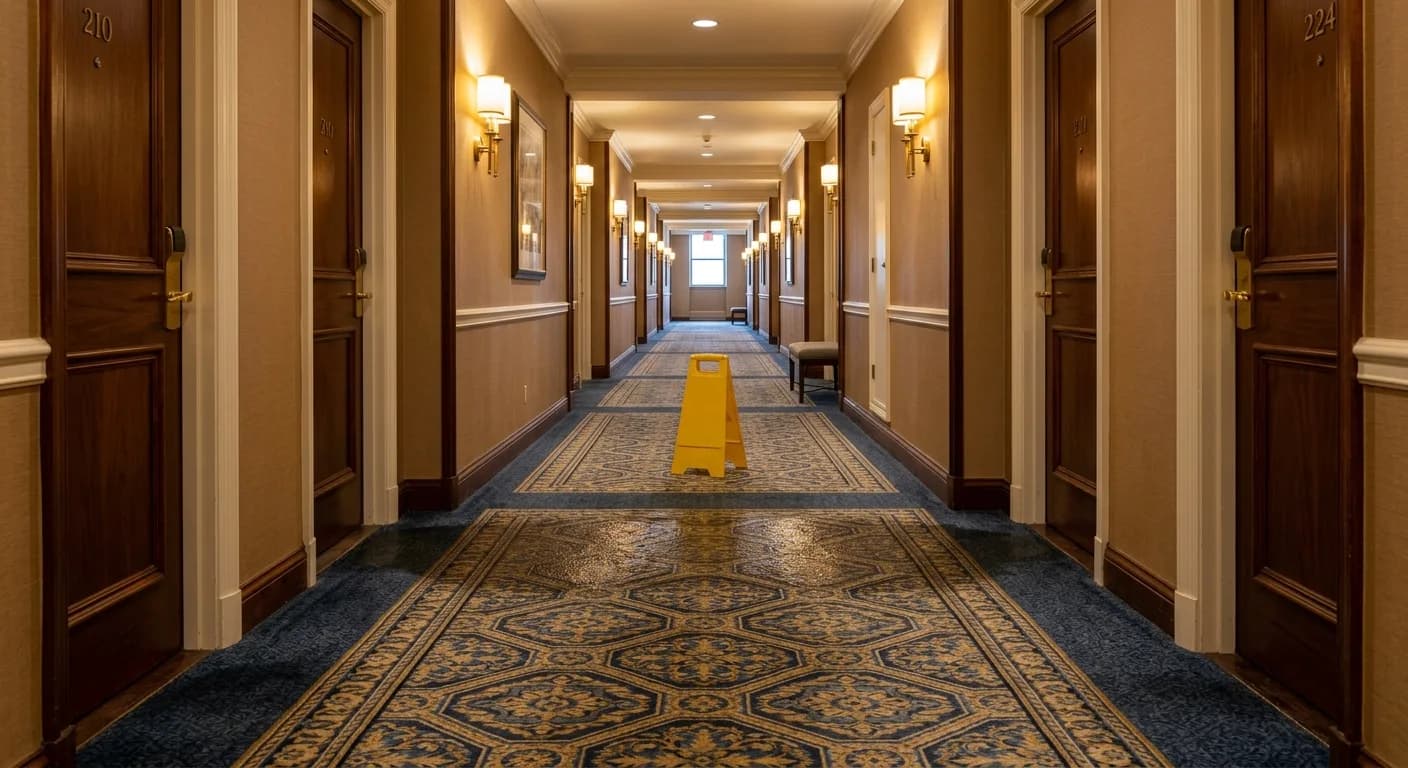
That is why casinos, hotel corridors, residential towers, function rooms and retail floors are almost always low-moisture work. There is no version of hot-water extraction that fits a four-hour window on a large floor, and forcing it produces a wet carpet in an occupied building — which is worse than a slightly less deep clean.
07FAQ
Frequently Asked Questions
Is low-moisture carpet cleaning in South Florida available for large commercial properties?
Yes. Larger buildings can be planned in phases so the work fits around daily operations.
Can this be combined with carpet cleaning?
Yes. Many clients combine services so carpets, upholstery, and other surfaces are addressed in one visit or planned maintenance schedule.
How do I know what method I need?
Power Carpet Cleaning can review the surface condition, use of the space, and drying requirements before recommending a method. Ready to plan the service? Contact Power Carpet Cleaning.
08On Low Moisture
What we have learned on the job.
The procedure, the chemistry and the machines, written out in full.