Yacht and Marine Carpet: Salt, Damp and Departure Dates
A yacht has wool carpet, salt air, no ventilation to speak of and a departure date that does not move. Every one of those makes moisture the thing to control.
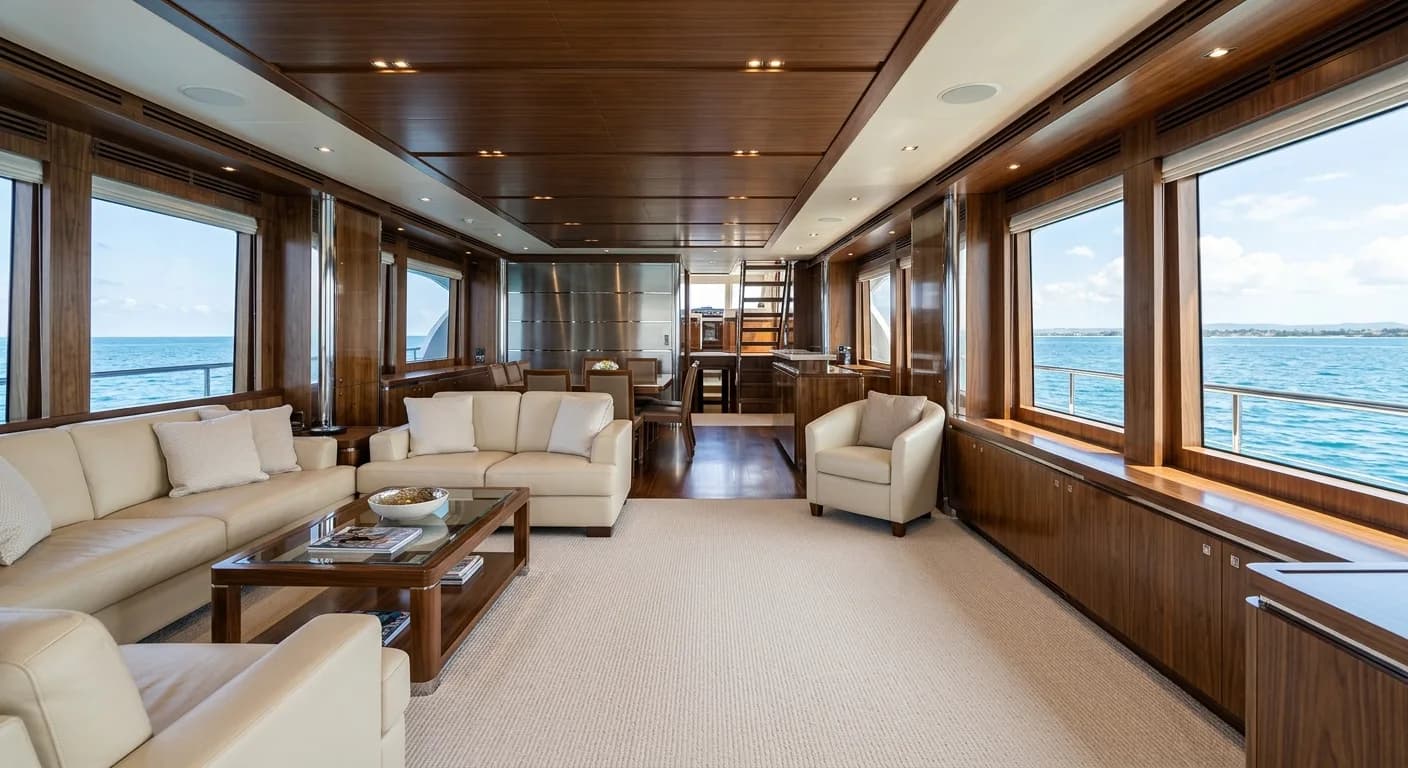
Yachts are one of the property types we are set up for, and they combine almost every difficult condition in carpet care at once: expensive natural-fibre carpet, a salt-laden atmosphere, very limited ventilation, confined access, and a departure date that is not negotiable.
Each of those points in the same direction. Whatever else happens, control the moisture.
The carpet is usually wool, and wool sets the rules
Marine interiors are specified for appearance and longevity, which in practice means wool — one of the finest face yarns available for carpet, with excellent soil-hiding and soil-release characteristics.
Soil hiding is the first trap. Wool looks clean long after it has stopped being clean, so a yacht's carpet is very often more soiled than it appears and correspondingly under-vacuumed. Vacuuming is not optional here; 80 per cent of what is in the pile is dry soil, and adding solution to a carpet still full of it makes mud.
The second is chemistry. Wool is sensitive to alkaline chemicals above 9.5 pH after prolonged exposure, and the recommended cleaning range is 4.5 to 8.5. A wool-safe alkaline pre-spray must sit at or below 8.5, and the rinse is where the job is really decided.
The rinse does more than rinse
Wool is finished with a concentrated acidic neutralising agent in the final rinse of the extraction process, at 3.0 to 5.0 pH. It rinses out soil and residue better than conventional acid rinses or water alone — and it does several other things that matter aboard a vessel.
It stabilises the dyes. It works to prevent browning and yellowing. It brings the carpet back to a neutral pH, which is where wool should be left after cleaning. It limits resoiling. And it leaves the fibre soft, which on a floor that people walk barefoot across is not a cosmetic detail.
Browning and yellowing deserve emphasis in a marine interior, because they are moisture-driven and a yacht is the most moisture-hostile environment a wool carpet can be in.
Why low moisture is usually the answer
A vessel does not dry like a building. There is little air movement, humidity is high, the space is enclosed, and salt air holds moisture rather than carrying it away. Carpet that would dry in four hours ashore can stay damp far longer aboard.
Damp wool is where every serious problem starts: browning, wicking, and on woven wool shrinkage, which cannot be reversed.
So the method is chosen by dry time before anything else. Low-moisture encapsulation dries to the touch in 20 to 60 minutes and returns carpet to light foot traffic in two to four hours, and on most vessels that is the correct choice. Where restorative extraction is genuinely needed, it is done with the least water the job allows and with forced drying running throughout — air movers, and the vessel's own air conditioning at full output.
The departure date is the schedule
Yacht work is planned backwards from a sailing date that does not move. That has two consequences worth stating.
The first is that the work has to finish dry, not merely finish. A carpet handed over damp on the morning of departure is a carpet that will spend the next week enclosed in a warm, humid, unventilated space — which is how a clean becomes a smell.
The second is that the whole job has to be planned around access and sequence. Confined spaces, limited power, and one route in and out mean the pattern of work matters as much as the method: plan the runs, do not carry equipment back across carpet that is still damp, and clean in an order that leaves a dry path out.
Salt, and what it does between cleans
Salt is hygroscopic — it draws moisture from the air and holds it. Salt carried into a carpet on feet does not simply sit there like ordinary grit; it keeps the fibre slightly damp and it accelerates soiling.
Which makes the same three interventions that work ashore matter more here: matting at every point of entry, vacuuming that keeps pace with use, and immediate spot response. On wool, spots get a neutral pH wool-safe spotter only, worked from the outside inwards, never scrubbed, and blotted dry — the wrong chemistry on wool does not leave a mark, it removes the colour.
More on marine work at yachts and private vessels and cruise ships and vessels, and on the fibre at wool and silk cleaning.
Need this handled in your building?
Serving Broward, Miami-Dade and Palm Beach counties.