
Training Your Own Staff to Spot-Clean
The person who finds the spill decides whether it becomes permanent. That person almost never works for the cleaning contractor, which is where most carpet is actually lost.
Almost everything written about commercial carpet assumes the contractor is present. For the single most consequential moment in a carpet's life — the ten minutes after a spill — they never are.
Spots that are not addressed become deep soils that turn into permanent stains, make the carpet look old and result in premature replacement. That sequence is decided by whoever finds it, and that person works for the building.
The four steps, and nothing else
Training does not need to be long. It needs to be four steps that are always the same, whatever the spill:
- Remove as much as possible first, by vacuuming or blotting. Everything lifted dry is something no solution has to carry away.
- Work from the outside inwards. Starting in the middle pushes the edge outward and makes a coin-sized problem a plate-sized one.
- Do not scrub. Scrubbing distorts the pile permanently, and distorted pile catches light differently — the mark stays visible after the substance is gone.
- Apply weight or pressure to lift as much dirty solution as possible into a white towel. What stays in the carpet is what wicks back to the surface tomorrow.
On wool, one addition: a neutral pH wool-safe spotter only, then blot dry. Wool holds dye to the core of the fibre, so the wrong chemistry does not leave a mark — it removes the colour.
The rule that saves the most carpet
Spot removers remove spots, not stains. If a mark has resisted two correct attempts, it is a stain, and it gets logged rather than attacked with something stronger.
This is the hardest thing to train, because it runs against the instinct of a conscientious person. Almost every permanent stain we are called to began as a treatable one that somebody kept working on — and a mark that has been scrubbed with the wrong product is frequently no longer recoverable by anyone.
"Stop and log it" is a skill. It should be stated as explicitly as the four steps.
Stock one broad product, not six specialised ones
In practice staff rarely know what caused a spot. Somebody found it; nobody saw it happen. So it is wise to keep a spot remover designed to treat a variety of spots — the broader the applicability, the better the chance of removing something nobody can identify.
Beyond that, the categories worth a dedicated product are the ones present in your building specifically: coffee almost everywhere, red dye where drinks are carried, grease near food service, ink in offices and schools.
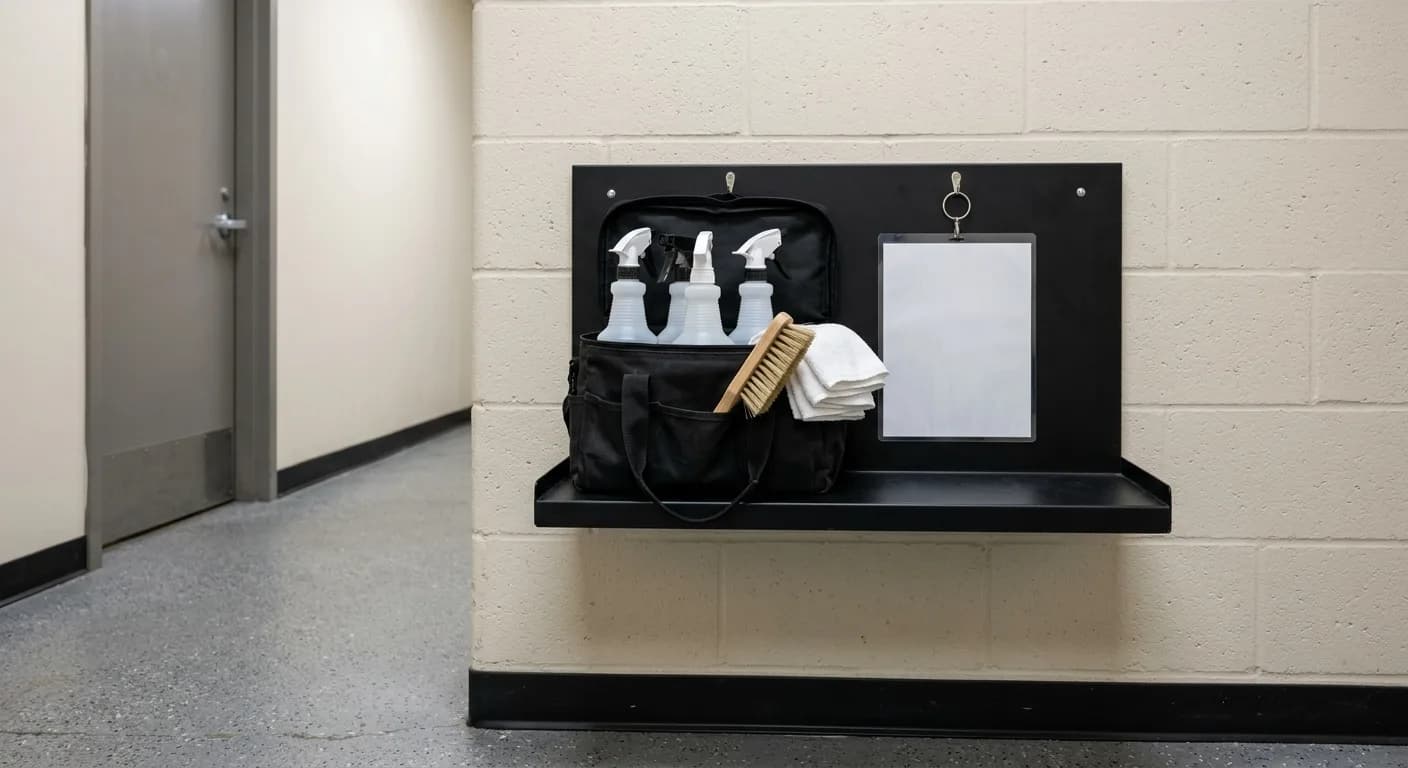
And a laminated guide in the bag. Every other item requires knowing which one to reach for, and the person standing over the spill has thirty seconds and no reason to have memorised nine stain categories.
Where the kit lives matters as much as what is in it
Near the spills, not in the store room. Response time is the variable that decides outcomes, and a kit two floors away is a kit that gets used tomorrow morning instead of now.
In practice that means more than one kit in most buildings: one near food service, one at reception, one on each floor of a tower.
Why this is worth doing even with a contract
There is a version of this conversation where a contractor discourages it, because spot work is billable. That is short-sighted in both directions.
A building whose staff handle first response has fewer permanent stains, a carpet that looks consistent rather than accumulating marks, and a maintenance programme that spends its money on the scheduled work rather than on rescues. The contractor gets a floor that reflects well on them and a customer who renews.
It is also the reason the most common arrangement we end up in is a combination: the building's own staff handle spotting, properly equipped and trained, and we do the work that needs equipment and certification.
We run this training on site and supply the kits — see consultation and training, and specialty stain removal for what is past first response.
Need this handled in your building?
Serving Broward, Miami-Dade and Palm Beach counties.