
Spot or Stain? The Difference Decides What You Can Do
Spot removers remove spots, not stains. The difference is not pedantry — it decides whether your cleaning staff can fix it or whether it needs a specialist, and it is usually decided in the first ten minutes.
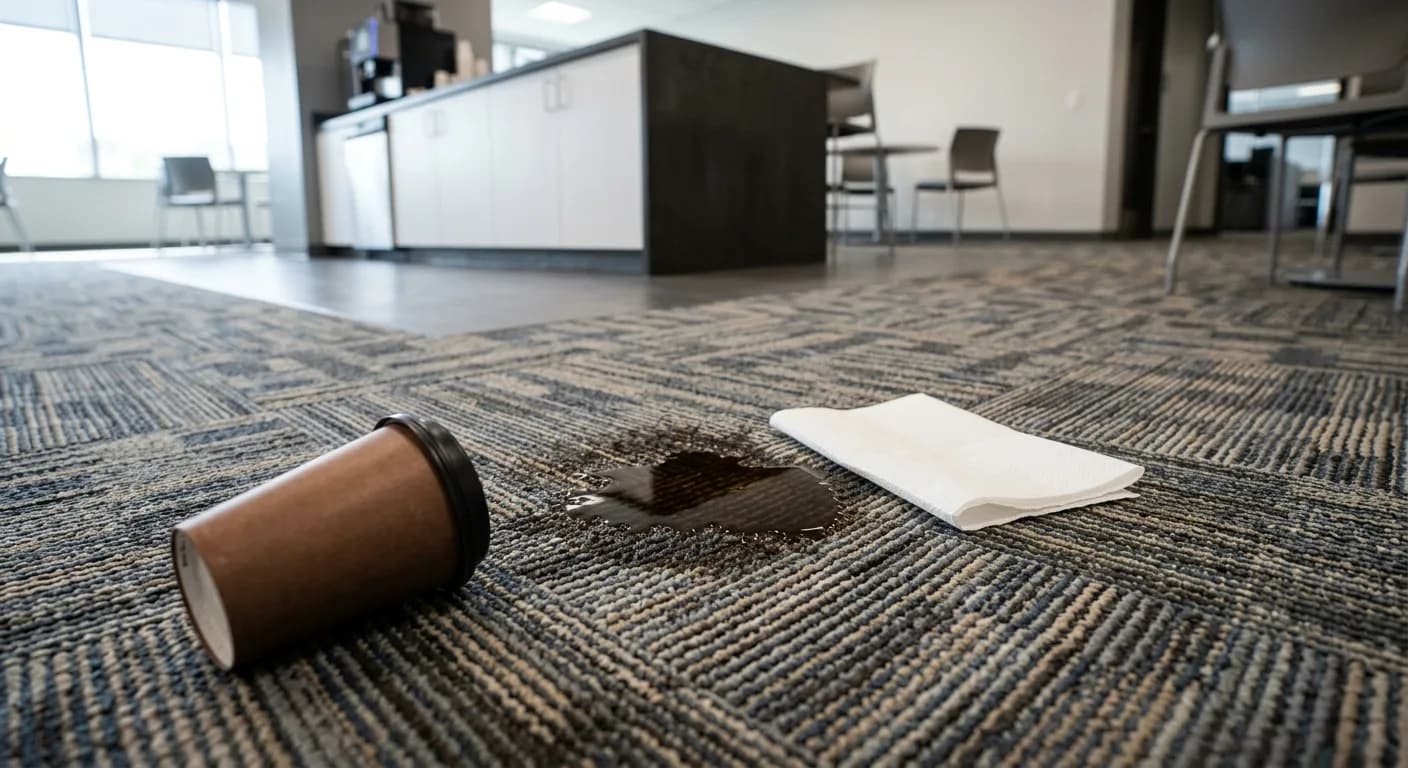
There is a distinction in carpet care that sounds like semantics and is not. A spot is a substance sitting on or in the fibre. A stain is what happens when that substance has been left to bond with it. Carpet spot removers are designed to remove spots, not stains — and once the second has happened, the products your cleaning staff have in the cupboard are no longer the right tool.
Almost everything about spot response follows from that one line.
Why waiting is the expensive decision
When spots, stains or spills occur, they cannot be allowed to remain until the next scheduled overall cleaning. It is critical that spots are addressed quickly, because otherwise they become deep soils — and deep soils are what make a carpet look old enough to justify replacing.
That is the actual cost. Not the mark itself, but the fact that a floor covered in old spots reads as a worn floor, and worn floors get replaced years before the fibre has failed.
Spots are also the part of carpet care most likely to be invisible until they are not. A great deal of what eventually shows up as a stain was never obviously a spill; it accumulated.
The procedure, and why the order matters
Where a spill has just happened, the sequence is what saves the carpet.
- Remove as much soil as possible first, by vacuuming or blotting. Anything lifted dry is not something a solution has to carry away later.
- Work from the outside of the spot inwards, using the appropriate cleaning product. Working the other way pushes the edge outward and turns a coin-sized problem into a plate-sized one.
- Do not scrub. Scrubbing distorts the pile, and distorted pile catches light differently — the mark stays visible after the substance has gone.
- Apply weight or pressure to pick up as much of the dirty solution as possible. What is left in the carpet is what wicks back to the surface tomorrow.
On wool, add one constraint: use a neutral pH wool-safe spot cleaner, and blot dry. Wool holds dye to the core of the fibre, which is exactly why the wrong chemistry on wool does not leave a mark — it leaves a different colour.
Choosing what to stock
It is wise to choose a spot remover designed to treat a variety of spots, because in practice you rarely know what caused the spot. Someone found it; nobody saw it happen. The broader the applicability of the product, the better the chance of removing it.
That argues for one good general spotter used correctly and immediately, rather than a shelf of specialised products that nobody is confident enough to reach for.
Where a building's own staff should stop
If a spot has become a stain, it must be treated accordingly. A professional can try repeated applications of an appropriate spot remover, and sometimes that is enough. In most cases it is not, and more specialised cleaners and procedures are needed to restore the carpet.
The categories that reliably need specialist treatment are the ones that do not come out in the general clean at all: coffee, soda, red food dye, wine, food and protein stains, rust, gum, tar and grease. Each needs a different method. Attacking them with a general-purpose spotter and enough enthusiasm is how a removable spot becomes a permanent one.
Having a well-stocked spotting kit and a well-trained staff helps enormously — and the training matters more than the kit. Knowing which four of those categories are in the building and what to do in the first ten minutes is worth more than any product.
The stains that need specialist work are covered on our specialty stain removal page, and we will train your staff on the first-response procedure — see consultation and training.
Need this handled in your building?
Serving Broward, Miami-Dade and Palm Beach counties.