
Restaurant Carpet: Grease, Traffic and Health Inspections
Restaurant carpet has a soil that most commercial carpet does not: airborne grease. It changes what cleaning has to do, and it explains why the usual schedule fails.
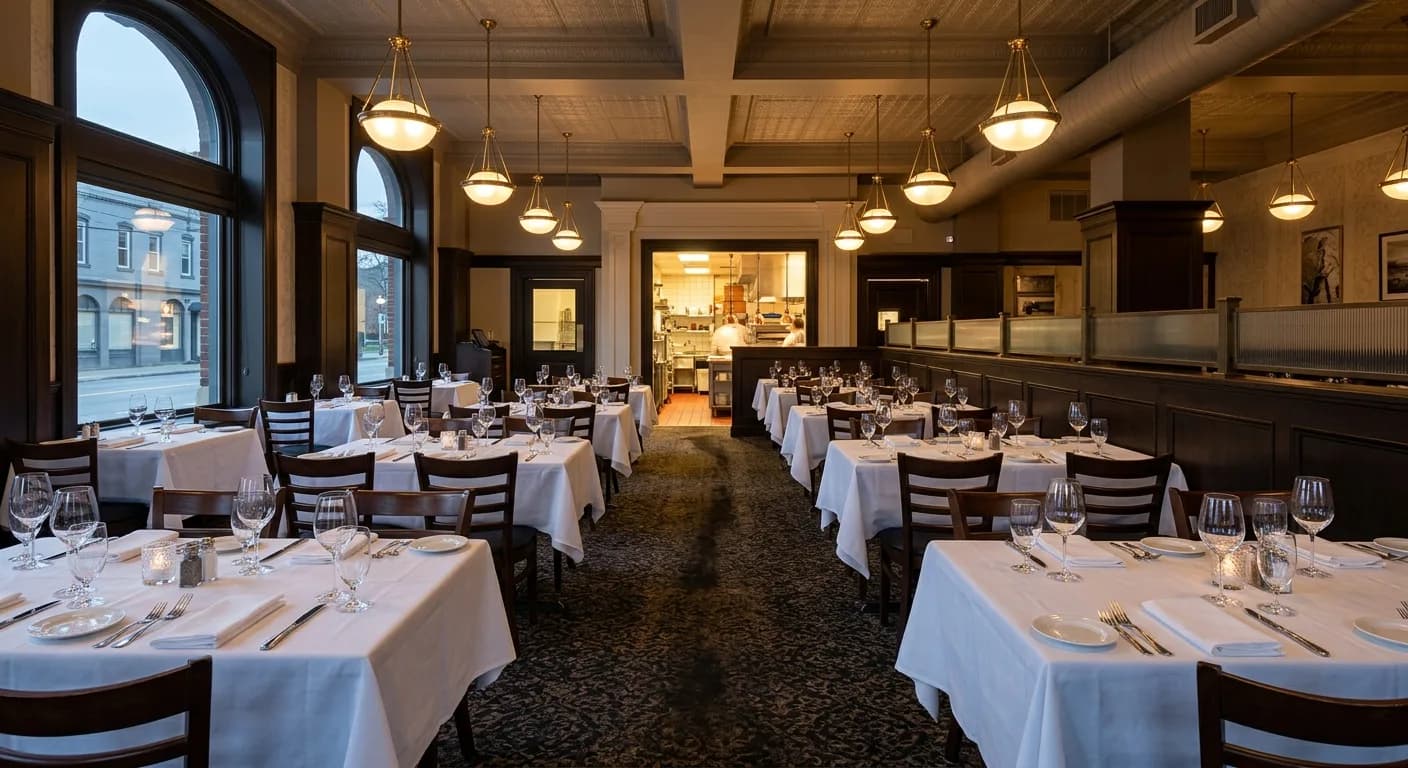
Restaurant carpet fails faster than almost any other commercial floor, and the reason is a soil type most buildings do not have to deal with: grease that arrives through the air rather than on feet.
Cooking puts an aerosol of oil into the room. It settles on every horizontal surface, carpet included, and it does not behave like dry soil at all. It is sticky, so it captures and holds the grit that walks in. It is not removed by vacuuming. And it spreads outward from the kitchen on shoes, which is why the worst carpet in a restaurant is rarely in the dining room proper — it is on the routes between the kitchen and the tables.
Why the usual schedule does not hold
A maintenance programme built around dry soil assumes that vacuuming removes most of the problem, which is normally true — 80 per cent of the soil in commercial carpet is dry.
Grease inverts that. It bonds the dry soil to the fibre, so the vacuum stops being able to lift it, and the carpet begins accumulating rather than cycling. A restaurant floor cleaned on an ordinary interim schedule will look acceptable for a fortnight and then darken along the service routes, and each clean will start from a worse baseline than the last.
What is needed is not more frequency but a step that addresses the grease directly.
Enzymes work on the source, not the surface
An enzyme pre-spray does something a detergent does not. A detergent lifts and suspends soil so it can be rinsed away. An enzyme breaks it down into something that is no longer the original substance.
On the two soils that dominate a restaurant that is exactly right: grease and oils dissolve in minutes, and protein soils are digested and readied for complete removal by the cleaning that follows. Protein covers food, dairy, and everything else that produces odour rather than a visible mark.
The dwell time is the part that gets cut and must not be. The product goes on lightly over the soiled areas and is allowed to sit for five minutes before the proper cleaning procedure follows. Extract after ninety seconds and nothing has been digested — the floor gets cleaned by mechanical action alone, and the grease survives to bind the next fortnight of soil.
Zone the floor around the kitchen
Restaurant floors do not wear evenly and should not be scheduled evenly:
- Kitchen entrances and service routes — the grease load, and the highest frequency. These need vacuuming at least twice daily, not once.
- Table surrounds — food and drink spills, concentrated in a small area around each seat
- Entry and waiting areas — everything from outside, including sand and rain
- The open floor between them — the lightest load, and usually the area getting the same treatment as the rest
Spots, and the ones that are already permanent
The categories that will not come out in a general clean are all present in a restaurant at once: coffee, soda, red food dye, wine, food and protein stains, and grease. Each requires a different method.
Red dye deserves specific mention, because it is not a stain in the ordinary sense — it is a dye that has bonded to the fibre, and it has to be chemically broken down rather than washed out. A red spill dealt with immediately is usually recoverable. The same spill found the next morning, or scrubbed with the wrong product by someone trying to help, frequently is not.
Which makes a spotting kit near the service area, with a laminated guide and staff trained on the first four steps, more valuable in a restaurant than in almost any other commercial setting.
Odour is a separate problem
If a floor still smells after cleaning, the source was not removed — it is below the surface, still active, and washing the surface will not reach it. That is an enzyme problem, not a frequency problem. And where contamination has soaked through the backing into the cushion, no surface treatment reaches it and the honest answer is replacing the affected cushion.
The methods behind this are set out at commercial services, and the specialist stain work at specialty stain removal.
Need this handled in your building?
Serving Broward, Miami-Dade and Palm Beach counties.