
Ink, Paint and Shoe Polish: The Solvent Stains
Water-based cleaning cannot touch ink, paint or shoe polish, because none of them is water soluble. A different class of product does — and it was the ink that used to be permanent.
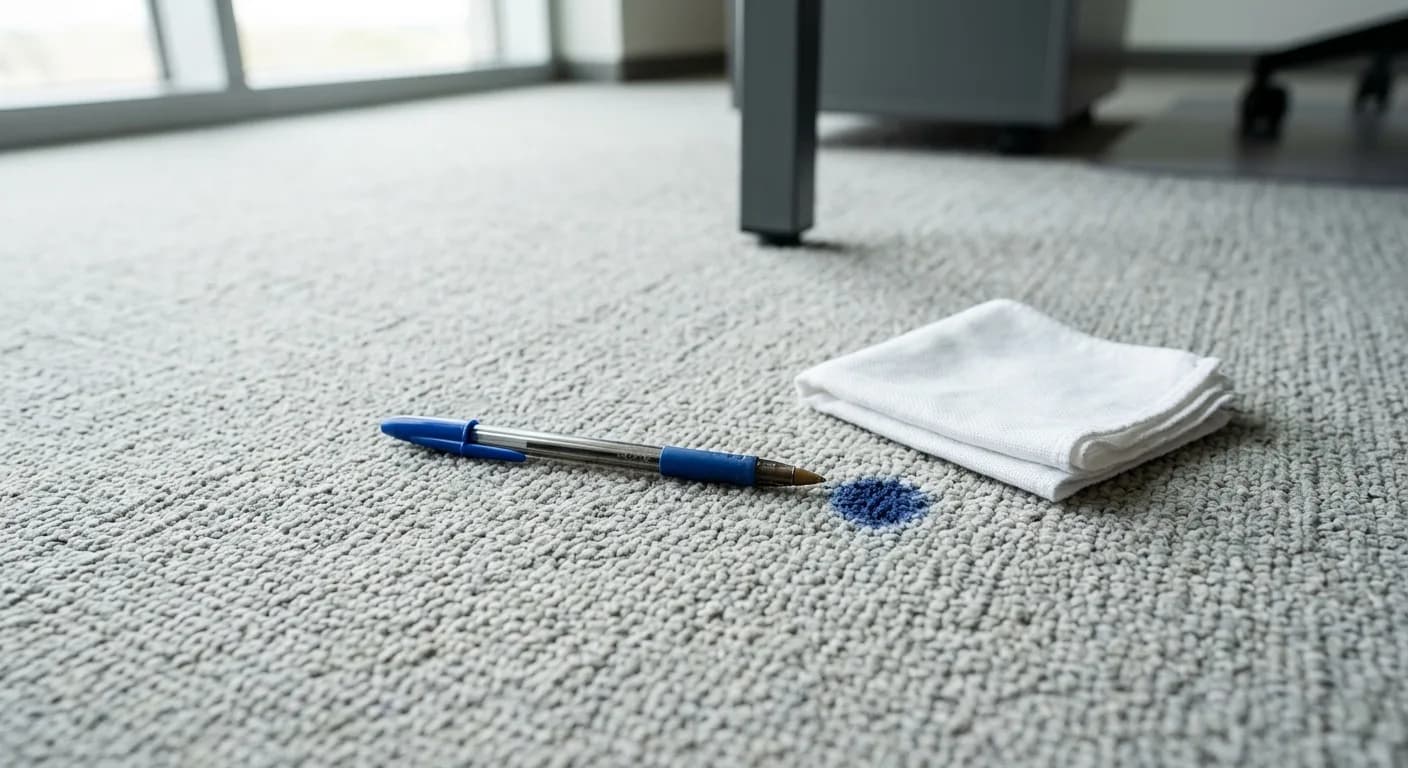
Ask most cleaning staff about the marks they cannot shift and the answers cluster: ballpoint pen, marker, shoe polish, something a contractor spilled, a sticky patch where a label was.
They cluster for a reason. Every one of those is oil- or solvent-based, and every water-based cleaning product in the cupboard is chemically incapable of removing them. It is not a question of effort or dwell time. The chemistry is wrong.
The category, in full
What needs a solvent rather than a detergent turns out to be a long and very ordinary list. Paint. Ballpoint pen. Stamp pad ink. Duplicating ink. Marking ink. Writing ink. Felt tip. Coloured art inks. Shoe polish. Cosmetics. Adhesives.
Look at that list against a commercial building and it is obvious why these keep appearing. Offices have pens and markers. Schools have art inks. Hotels and residential buildings have cosmetics and shoe polish. Every building that has ever had a contractor in it has paint and adhesive residue somewhere on the carpet.
Why the usual approach makes it worse
The instinctive response to an ink mark is a general spotter and vigorous work with a cloth. Both halves of that are wrong.
The spotter cannot dissolve the ink, so nothing is removed — but the moisture and the agitation spread it. An ink mark worked at with water typically grows from a spot to a halo, and the halo is a much larger area to treat afterwards. Scrubbing adds a second, permanent problem: distorted pile catches light differently, so the mark stays visible even after the colour has gone.
These are also exactly the stains most likely to be attacked repeatedly, because each attempt appears to be nearly working.
What a proper solvent spotter does differently
The product for this category is a non-volatile multi-purpose solvent, and two of those words are doing real work.
Non-volatile means it does not flash off in seconds. It stays on the stain long enough to dissolve it, which is what allows a spot to be treated deliberately rather than in a panic — and it means less vapour in an occupied building.
Multi-purpose matters because in practice you rarely know exactly what the mark is. Somebody found it; nobody saw it happen. A product that covers the whole ink-and-oil category is far more useful than four specialised ones that require correct identification first.
The useful property, though, is that it is both water soluble and solvent soluble. Most of the time the stain comes out by applying the product, adding water and extracting — ordinary equipment, ordinary process. Where solvents are more appropriate, the same product can be flushed with a volatile solvent instead. One product, two routes, chosen by how the stain responds.
Ink stains that were previously thought permanent are removable this way, including heavy ink deposits on upholstery where other products had failed. Paired with a rinsing agent afterwards, it is the difference between a written-off panel and a cleaned one.
The order of operations
The first-response sequence still applies, and it applies harder here:
- Do not add water first. On a water-based spill, blotting comes first. On ink and paint, water spreads the problem before the solvent has had a chance to lift it.
- Work from the outside inwards. This category spreads more readily than any other.
- Do not scrub. Distorted pile stays visible after the mark is gone.
- Apply weight or pressure to lift the dissolved material into a white towel. Use white — a coloured cloth can transfer its own dye into a carpet that has just been treated with a solvent.
- Rinse afterwards. Solvent residue left in the pile attracts soil, which turns a removed stain into a grey patch a fortnight later.
Where to stop
Two cautions are worth training into staff.
Solvents and delicate fibres are a poor combination. Anything on wool or silk should be treated as a specialist job rather than a first-response one — wool holds dye to the core of the fibre, and getting this wrong does not leave a mark, it removes colour.
And the general rule holds: spot removers remove spots, not stains. A mark that has resisted two correct attempts should be logged and left. Almost every permanent ink stain we are called to began as a treatable one that somebody kept working on.
The marks past first response are what our specialty stain removal work is for, and we will train your staff on the boundary at consultation and training.
Need this handled in your building?
Serving Broward, Miami-Dade and Palm Beach counties.