
Hotel Carpet: Corridors, Ballrooms and Turnover
A hotel is three carpet problems in one building, and they need three different schedules. Treating them as one floor is why corridors always look the worst.
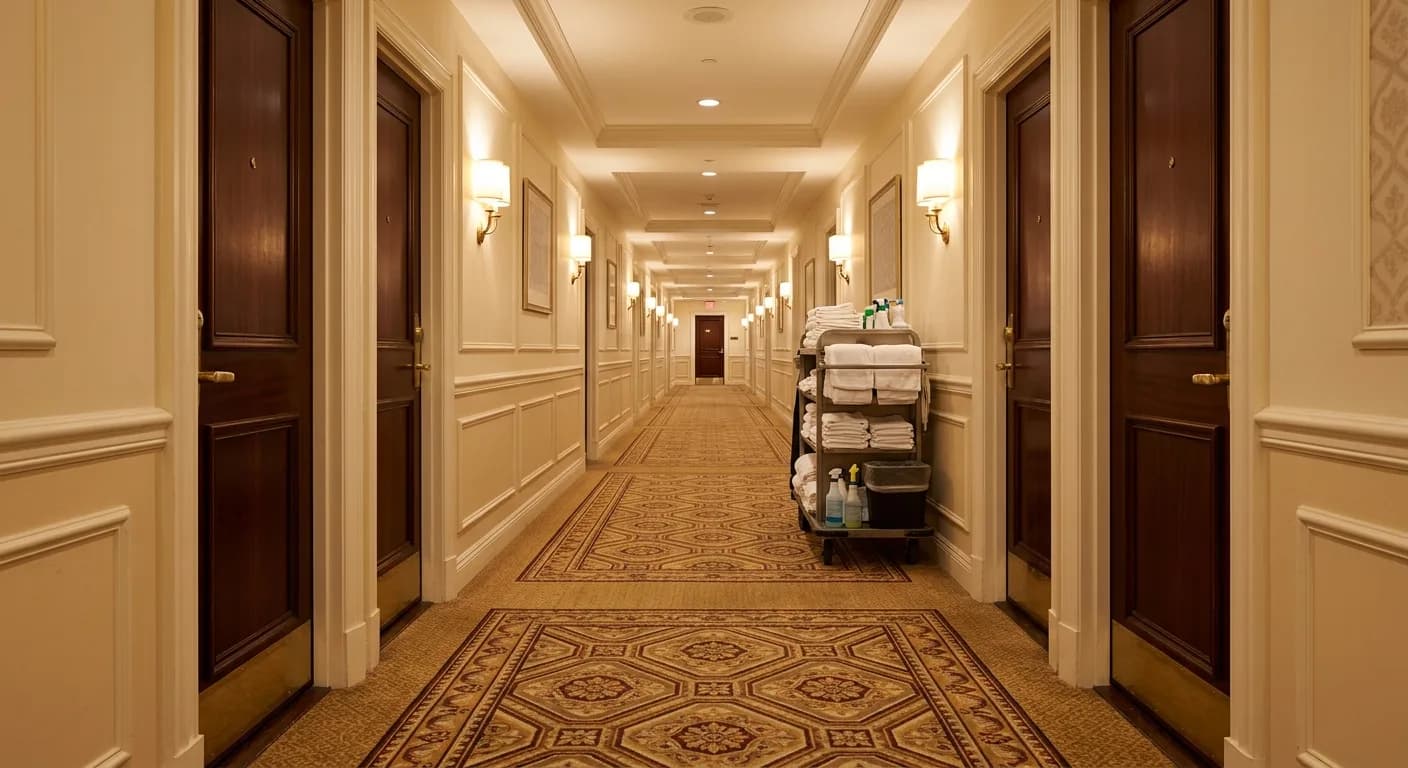
Ask a hotel where its carpet problem is and the answer is almost always the corridors. That is correct, and it is a symptom of something structural: a hotel is at least three different carpet environments, and most maintenance programmes treat it as one.
Three floors, three problems
Corridors carry every guest, every housekeeping trolley and every suitcase wheel in the building, along a narrow line that concentrates all of it. They are also never empty — there is no hour at which no guest is moving through a hotel corridor — so they are simultaneously the highest-wear carpet and the hardest to take out of service.
Function and ballroom space has the opposite profile: long idle periods punctuated by very heavy, very messy use. Food, drink, hundreds of people, furniture dragged across the pile. The soil arrives in concentrated bursts, and the cleaning window is whatever gap exists between one booking and the next.
Guest rooms are the lightest traffic in the building and the most sensitive to smell, because a guest spends eight hours with their face two feet from the carpet. Appearance matters less here than odour and dryness do.
One frequency across all three over-cleans the rooms and under-cleans the corridors, which is exactly the pattern most hotels end up with.
Corridors: interim work, constantly
The answer for corridors is not deeper cleaning; it is more frequent appearance-level cleaning, concentrated where the traffic actually runs. Low-moisture encapsulation puts carpet back into light foot traffic in two to four hours, which is what makes it possible at all in a building with guests on every floor.
Corridors also reward sectioning. A floor cleaned in two halves, with one side always passable, is a floor that can be maintained without a single guest complaint — and that is usually a scheduling decision rather than a technical one.
Underneath it sits the vacuuming, which is the part that decides whether the interim cleans hold. Eighty per cent of what is in a corridor carpet is dry soil, and a housekeeping round that vacuums room doorways but hurries the corridor centre is leaving the abrasive part exactly where the wheels run.
Ballrooms: the window is the calendar
Function space is cleaned against a booking sheet rather than a maintenance schedule, which means the method has to fit whatever gap exists. Between a Saturday wedding and a Monday conference there may be a single overnight window for ten thousand square feet.
Low moisture is usually the only method that fits. Where a genuine restorative clean is needed — and after a heavy season it will be — it has to be booked into a gap in the diary weeks ahead, because a hot-water extraction on a ballroom floor is not something that can be squeezed into a Sunday morning.
Ballrooms are also where spot response earns its keep. Food and drink on a patterned floor, discovered late, is the reliable route to permanent marks.
Entrances decide all of it
Every floor care system starts at the door, and in a Florida hotel the door is the whole argument. Ninety-four per cent of the soil in any facility arrives on foot, and a beachfront or resort property is receiving sand and water together, continuously, at several entrances at once.
Matting inside and outside every exterior door, vacuumed daily as part of the round and replaced when it stops working, does more for the corridor carpet than any increase in cleaning frequency. A mat that is full has stopped collecting and started redistributing.
Wool in the places that matter
Ballrooms, executive floors and club lounges are frequently wool, and wool has a narrower tolerance than the nylon in the corridor: cleaning between 4.5 and 8.5 pH, an acidic neutralising rinse, careful moisture control and fast drying. The same contractor arriving with the same pre-spray for the whole building is how the most expensive floor in the hotel gets damaged.
Knowing which spaces are wool, and saying so before anyone arrives, is worth more than any other single piece of information a hotel can hand a contractor.
How we work in hospitality is set out at hotels and resorts, and the wool tolerances at wool and silk cleaning.
Need this handled in your building?
Serving Broward, Miami-Dade and Palm Beach counties.