A Spotting Kit Your Cleaning Staff Can Actually Use
A spotting kit that nobody is confident enough to open is decoration. Here is what belongs in one, and the training that makes the difference between using it and making things worse.
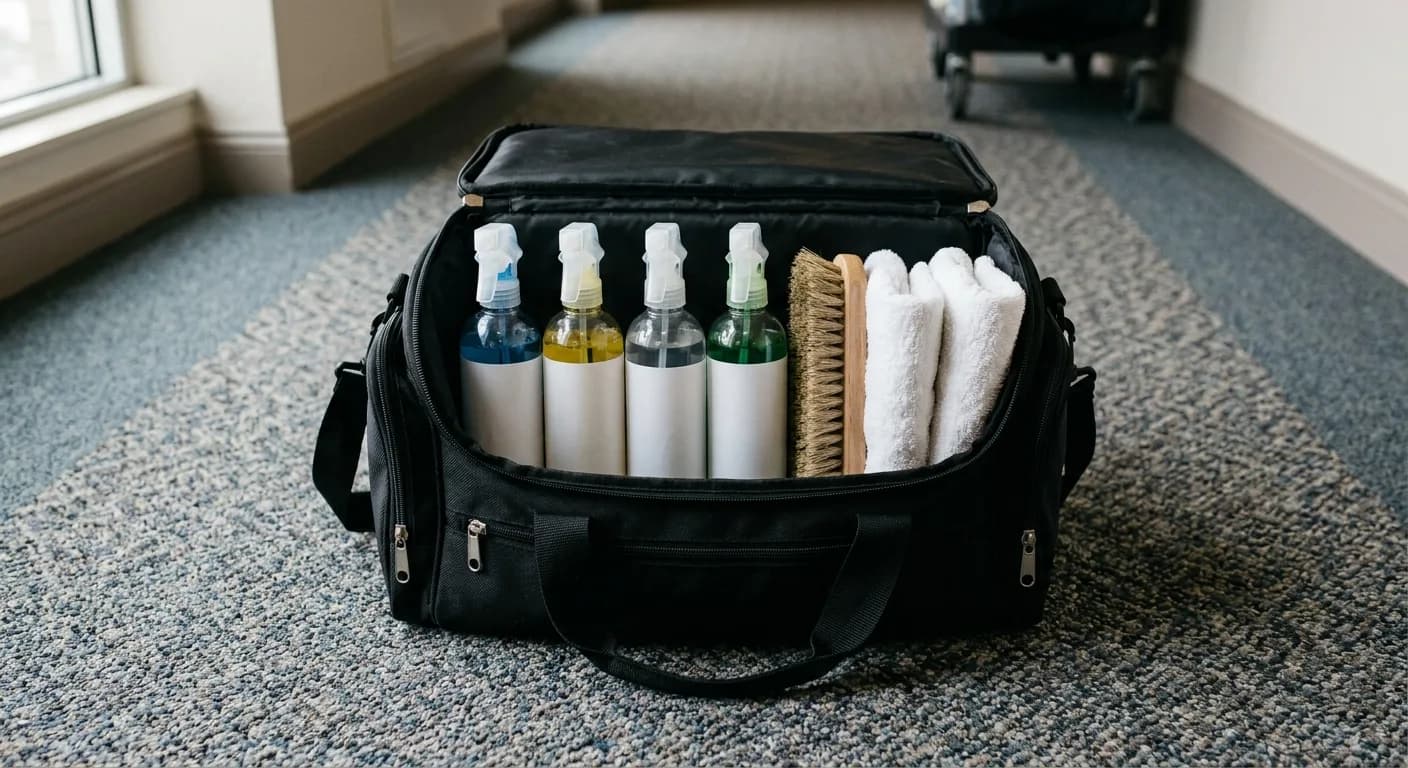
Most commercial buildings own a spotting kit. Rather fewer use it, because the person who finds the spill is rarely the person who knows what is in the bag — and using the wrong bottle confidently is worse than using nothing at all.
A kit is only as good as the training beside it. Both parts are worth getting right, because the alternative is a floor that accumulates marks until the whole thing looks old enough to replace.
The categories that need dedicated products
The stains that do not come out in a general clean fall into a predictable list: coffee, soda, red food dye, wine, food and protein stains, rust, gum, tar and grease.
Those are not interchangeable problems. Red dye needs a fundamentally different approach from grease, and protein needs a different one again — which is why a serious kit is a set of specific tools rather than one bottle labelled "carpet spot remover".
The kit we use and recommend contains a protein spotter, a solvent-based cleaner for oil and grease, a general spotter for the everyday marks, a rust remover, a coffee stain remover, a gum remover with a gel breaker, a trigger sprayer, a spotting brush and two spotting towels — with a laminated spotting guide in the bag.
The laminated guide is the most important item
That sounds like a joke and is not. Every other item in the kit requires knowing which one to reach for, and the person standing over the spill at four in the afternoon is a housekeeper who has thirty seconds and no reason to have memorised nine stain categories.
A guide that lives in the bag, survives being wet, and says this mark, that bottle is what converts a kit from equipment into a capability. If your kit does not have one, that is the cheapest improvement available.
The procedure to train, before any product
Whatever is in the bag, the sequence is the same and it is worth more than the chemistry.
- Remove as much soil as possible by vacuuming or blotting. Everything lifted dry is something no solution has to remove later.
- Work from the outside inwards. Starting in the middle spreads the edge and makes a small problem a large one.
- Do not scrub. Scrubbing distorts the pile permanently, and distorted pile stays visible after the substance has gone.
- Apply weight or pressure to lift as much dirty solution as possible into the towel. What stays in the carpet is what wicks back tomorrow.
On wool, one addition: a neutral pH wool-safe spot cleaner only, then blot dry. Wool holds dye to the core of the fibre, so the wrong chemistry does not leave a mark — it leaves a different colour.
Choose one broad spotter for the unknown case
In practice you often will not know what caused a spot. Somebody found it; nobody saw it happen. It is wise to keep a spot remover designed to treat a variety of spots for exactly that case, because the broader the applicability, the better the chance of removing something you cannot identify.
That is the everyday bottle. The specialised products are for when you do know, and knowing is what the guide is for.
Know where the kit stops
Spot removers remove spots, not stains. If a spot has been left to become a stain, repeated applications of an appropriate product sometimes work — and in most cases more specialised cleaners and procedures are needed to restore the carpet.
Training staff to recognise that boundary is as valuable as training them to use the kit. A mark that has resisted two correct attempts should be logged and left, not escalated with something harsher. Almost every permanent stain we are called to started as a removable one that somebody kept working on.
Where to put it
Near the spills, not in the store room. Response time is the variable that decides outcomes, and a kit two floors away is a kit that gets used tomorrow morning instead of now.
We supply kits, train staff on the procedure, and take the stains that are past first response. See consultation and training and specialty stain removal.
Need this handled in your building?
Serving Broward, Miami-Dade and Palm Beach counties.