
Walk-Off Matting and the 94% Rule
Ninety-four per cent of the soil in a building walked in on somebody’s feet. That makes matting the cheapest carpet care a facility can buy, and the most commonly neglected.
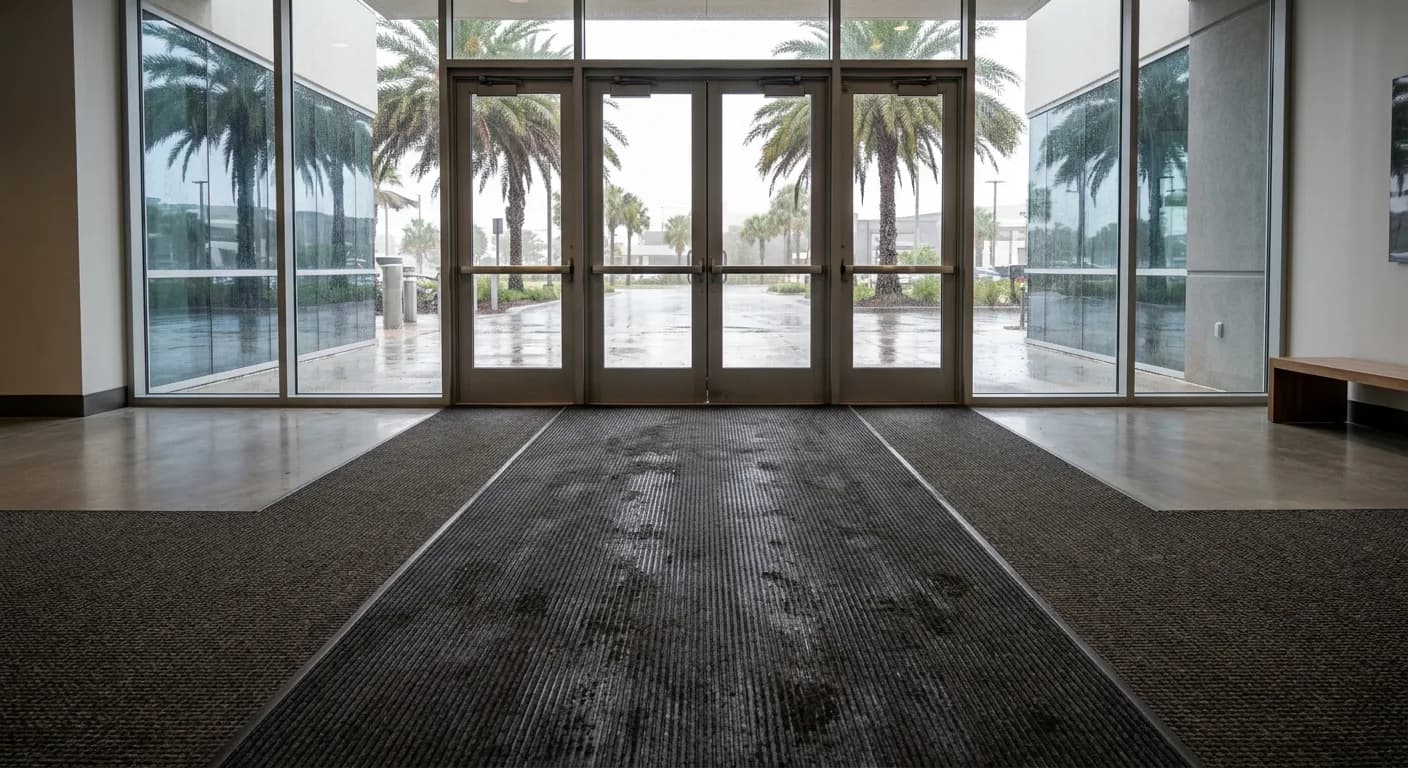
According to industry studies, 94 per cent of the soil in any facility was brought into the facility through foot traffic. Not through windows, not through the air handling, not generated inside. Walked in, through the doors, on shoes.
That single figure reorders the whole priority list. If nearly all the soil arrives at the door, then the building's biggest line of defence is a matting system — and every floor care system starts there. Proper matting is the first step to keeping grit and moisture off the floor.
Why it matters more here
South Florida makes this worse than the averages assume, for two reasons that arrive together.
The first is sand. What comes in on shoes in Broward, Miami-Dade and Palm Beach is quartz — hard, angular and abrasive. It does not merely sit in the pile looking dirty; it grinds against the fibre with every footfall. A traffic lane that has gone grey and flat has usually been abraded rather than stained.
The second is water. Afternoon rain in the wet season means feet arrive wet as well as sandy, and wet grit travels further into a building than dry grit does. Matting has to handle both: scrape the grit off and hold the moisture.
How much matting is enough
The practical answer is more than most buildings have. The soil load drops off along the length of the matted run, and a single mat inside a door catches the first step or two, which is the smallest part of the problem.
Look at where your carpet is actually failing. In almost every commercial building the worn zone is the first ten to fifteen feet inside the exterior doors, which is precisely the distance the matting was supposed to cover and did not.
Matting belongs on both sides of the door — inside and outside. The outside apron and approaches should be swept or power-washed as often as needed to keep outdoor soils at bay and as far away from the entrances as possible. Grit that never reaches the mat never has to be removed from the mat.
A mat only works while it is clean
This is the part that gets missed. A mat is a soil reservoir, and a full reservoir stops collecting. Once it is loaded it does the opposite of its job — it holds grit at the exact point where the most feet pass over it, and redistributes it.
So daily maintenance steps should include vacuuming the walk-off mats, like any other surface in the round. Entrance mats that become soiled should be cleaned, and replaced if they get too messy to recover.
Two areas earn more than daily attention: track-off areas and kitchen entrances should be vacuumed at least twice daily. Kitchen entrances add grease to the grit, and grease is what turns tracked soil into something that no longer vacuums out at all.
The rest of the daily routine
Around the matting sits the routine that handles the 80 per cent of carpet soil that is dry: a daily vacuuming schedule with a good commercial vacuum that uses a beater brush, and a quality commercial-grade pile lifter run weekly over the high-traffic areas.
It is extremely important to extract as much dry soil as possible before any cleaning, particularly in high-traffic areas, if the clean is going to achieve anything. Everything left behind becomes mud the moment solution is applied.
What it costs, and what it saves
Matting, mat cleaning and daily vacuuming are the cheapest interventions available to a facility and require no technician. Together they address the overwhelming majority of what damages commercial carpet.
Set that against the replacement cost of the floor. Most commercial carpet is replaced because it looks tired, and it looks tired because of the grit that walked through an unmatted door and was never taken out again.
We will set the routine up and train your staff to run it — see consultation and training, or read the wider programme at commercial services.
Need this handled in your building?
Serving Broward, Miami-Dade and Palm Beach counties.