Upholstery in Commercial Spaces: Cotton, Wool, Leather
Commercial upholstery is cleaned less often than the carpet under it, sits closer to people, and is less forgiving of moisture. All three argue for the same approach.
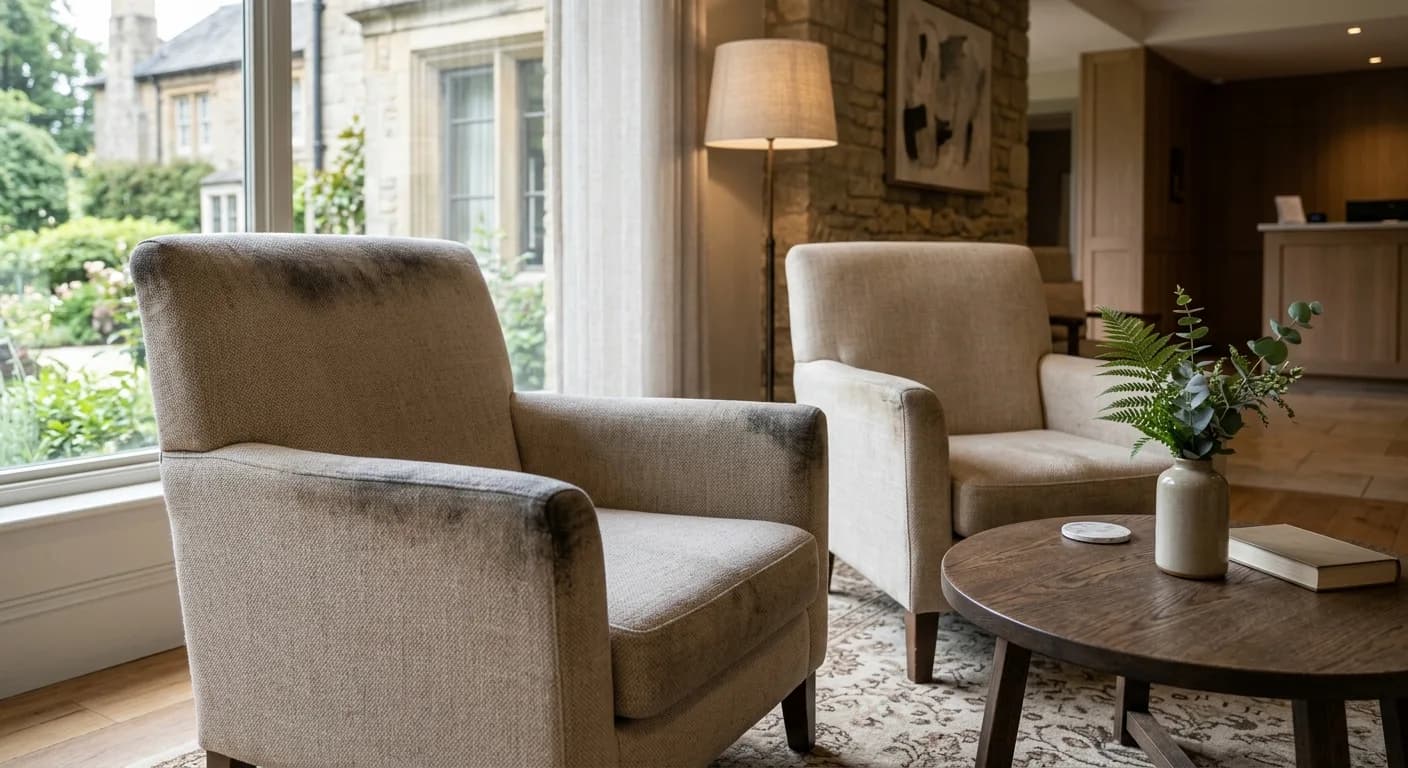
Upholstery is the part of a commercial interior that gets cleaned when somebody notices it, which is usually well after it needed it. It also sits closer to people than any other surface in the building — lobby seating, function chairs, waiting areas, cabin furniture — and is judged at conversational distance rather than from standing height.
The methods overlap with carpet cleaning. The tolerances do not.
Fibre first, and it is less obvious than carpet
Commercial upholstery covers cotton, wool, leather and a wide range of synthetics, frequently in the same room and sometimes on the same piece.
Wool upholstery carries the same constraint as wool carpet: cleaning between 4.5 and 8.5 pH, because above 9.5 prolonged exposure damages the fibre, and it holds dye to the core so the wrong chemistry removes colour rather than a mark. Cotton is absorbent and prone to browning and to watermarks if it is over-wetted or dried unevenly. Leather needs an entirely different approach from either.
Unlike carpet, upholstery usually carries a manufacturer's cleaning code on a label under the cushion. It takes thirty seconds to find and it settles the question. A contractor who does not look for it is guessing.
Moisture is the constraint, more than on carpet
Carpet sits on a floor and can be dried with air movers. Upholstery is a three-dimensional object with a frame, padding and cavities inside it, and moisture that gets into the fill has no easy way out.
That produces the specific failure modes of upholstery work — watermarks and rings where a damp area dried unevenly, browning wicking up from the fill on cotton, and odour where something biological in the padding was never dried out.
So the method is chosen by dry time before anything else, and that is why a fast-drying low-moisture shampoo approach is usually the right answer for commercial furniture rather than the wettest method available.
Where the soil actually is
Upholstery soils in a pattern as predictable as a carpet's, and cleaning it evenly is as wasteful:
- Arms and headrests take skin oils and hair products — an oily soil that is not water soluble and that vacuuming does not touch
- Seat fronts and cushion edges take abrasion and transferred soil from clothing
- Between and beneath cushions collects dry soil and food debris that nobody removes
- Backs and sides are often close to new
Body oils are the reason upholstery goes dark at the contact points rather than dirty all over, and the reason a general water-based product often disappoints. Those areas need a pre-treatment aimed at oil before any general cleaning.
The steps that matter
Vacuum thoroughly first, including the crevices — the same principle as carpet, where 80 per cent of what is present is dry soil and adding solution to it makes mud.
Treat the spots that will not come out in a general clean before starting: food and protein, grease, ink from pens carried in pockets, and cosmetics on headrests. Each needs its own method.
Then clean with as little moisture as the job allows, rinse to a neutral pH so no residue is left to attract soil, and dry actively rather than leaving the room to do it.
Fitting it into a programme
Upholstery belongs in the maintenance schedule alongside the carpet, on its own frequency, with the same usage ratings applied. Lobby and function seating in an occupied building will need attention several times a year; a boardroom chair may need it annually.
Doing it in the same visit as the carpet is simply efficient — one mobilisation, one window, one set of caution signs. Doing it as a separate emergency, when somebody finally notices the arms have gone dark, is how it ends up being replaced instead.
Upholstery is part of what we do on every commercial engagement — see commercial services or arrange a site assessment.
Need this handled in your building?
Serving Broward, Miami-Dade and Palm Beach counties.