
Theatres and Venues: Cleaning Around a Dark Day
A theatre gets one dark day, and everything that cannot happen during a run has to happen in it. The carpet is competing with the get-out, the rig and the repairs.
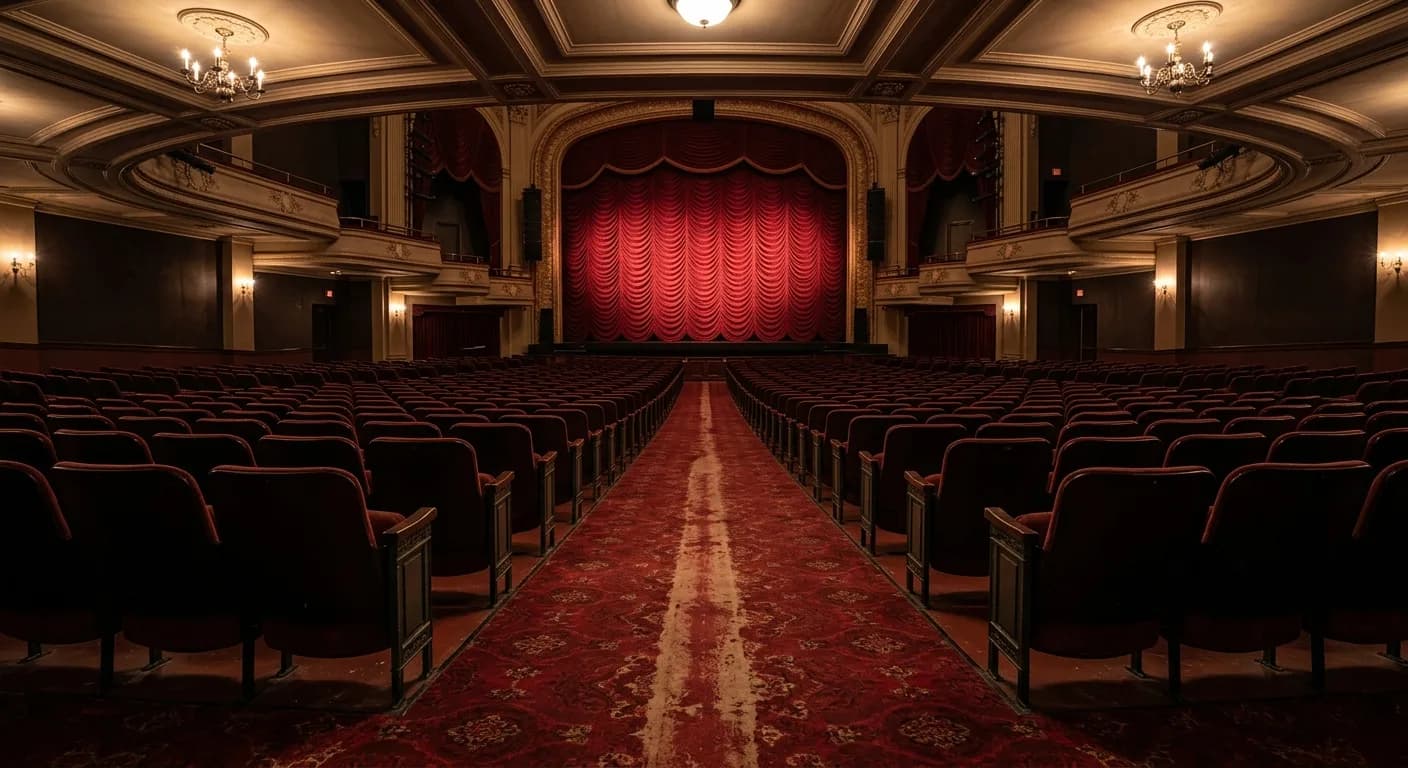
A theatre's carpet has an unusual problem: the building is busy in the evenings, occupied during the day by people working on the next production, and genuinely available almost never.
There is typically one dark day, and it is already spoken for. A get-out, a rig, maintenance that could not happen during a run, deliveries. Carpet cleaning is competing for that day with everything else the building has deferred.
The wear is extremely concentrated
Auditorium carpet wears in a pattern sharper than almost any other commercial floor. The aisles carry every member of every audience. The area at the top of each aisle, where people pause and turn, wears faster still. Under the seats, almost nothing happens at all.
Foyers and bars take the pre-show and interval crowd — a very heavy load compressed into two short bursts per performance, with drinks in hand for most of it.
The ratio between the busiest and quietest carpet in a theatre is extreme, which makes uniform cleaning particularly wasteful. Aisles and foyers may need interim work many times a year while the seating rows need a restorative clean once.
It also means the carpet's true colour survives under the seats. A house that looks tired is almost always one where the aisles have drifted away from that reference.
Fitting the work to the day you get
With one available day and a performance the next evening, dry time decides the method. Low-moisture encapsulation dries to the touch in 20 to 60 minutes and returns carpet to light foot traffic in two to four hours. Hot-water extraction does not fit, and forcing it produces a damp auditorium for an audience — worse than a slightly less deep clean.
Restorative work belongs in a genuine break: between productions, or in whatever annual closure the venue has. Those gaps are few and every venue in the region wants the same weeks, so they have to be booked well ahead.
One detail helps. Encapsulation cures over about 24 hours, and the crystallised soil comes out with the next vacuuming rather than with our machine. Cleaning on a dark day and vacuuming before the next performance produces a better result than cleaning the morning of the show.
Working around fixed seating
Fixed seating makes an auditorium slow. Access between rows is narrow, machines have to be compact, and the pattern of work has to be planned so equipment is never carried back over carpet that has just been cleaned.
Aisles are the priority and they are the easy part — long, clear runs that take treatment well. The rows are where the time goes, which is a reason to treat them on a genuinely long cycle rather than pretending they need the same attention as the aisles.
Food, drink and the dark
Theatres and cinemas combine two things that are hard on carpet: food and drink carried into the auditorium, and lighting that makes spills invisible until the house lights come up.
That delay is the whole problem. Spots that are not addressed become deep soils that make a carpet look old and lead to premature replacement, and the categories present in a venue are exactly the ones that will not come out in a general clean — coffee, soda, red food dye, wine, food and protein stains, and grease from confectionery.
Red dye deserves specific attention: it is not a stain so much as a dye that has bonded to the fibre, and it must be chemically broken down rather than washed out. Found promptly it is usually recoverable. Found a week later, or scrubbed with the wrong product, frequently not.
The practical answer is a spotting kit at each level with a laminated guide, front-of-house staff trained on four steps — blot, work outside-in, do not scrub, apply weight — and a habit of walking the aisles with a torch after the house clears rather than discovering it at the next performance.
Underneath it, the ordinary things
Matting at every public entrance, because 94 per cent of the soil in any facility walks in through the doors. Vacuuming the aisles and foyers far more often than the rows. And pile lifting on the aisle runs, where embedded grit is what actually wears the carpet out rather than what makes it look dirty.
More on venue work at theatres and cinemas and stadiums and arenas.
Need this handled in your building?
Serving Broward, Miami-Dade and Palm Beach counties.