
Study the Building Before You Write the Programme
A maintenance programme written from a square-footage figure will be wrong. The information that makes it right is in the building, and most of it can be gathered in an hour of walking.
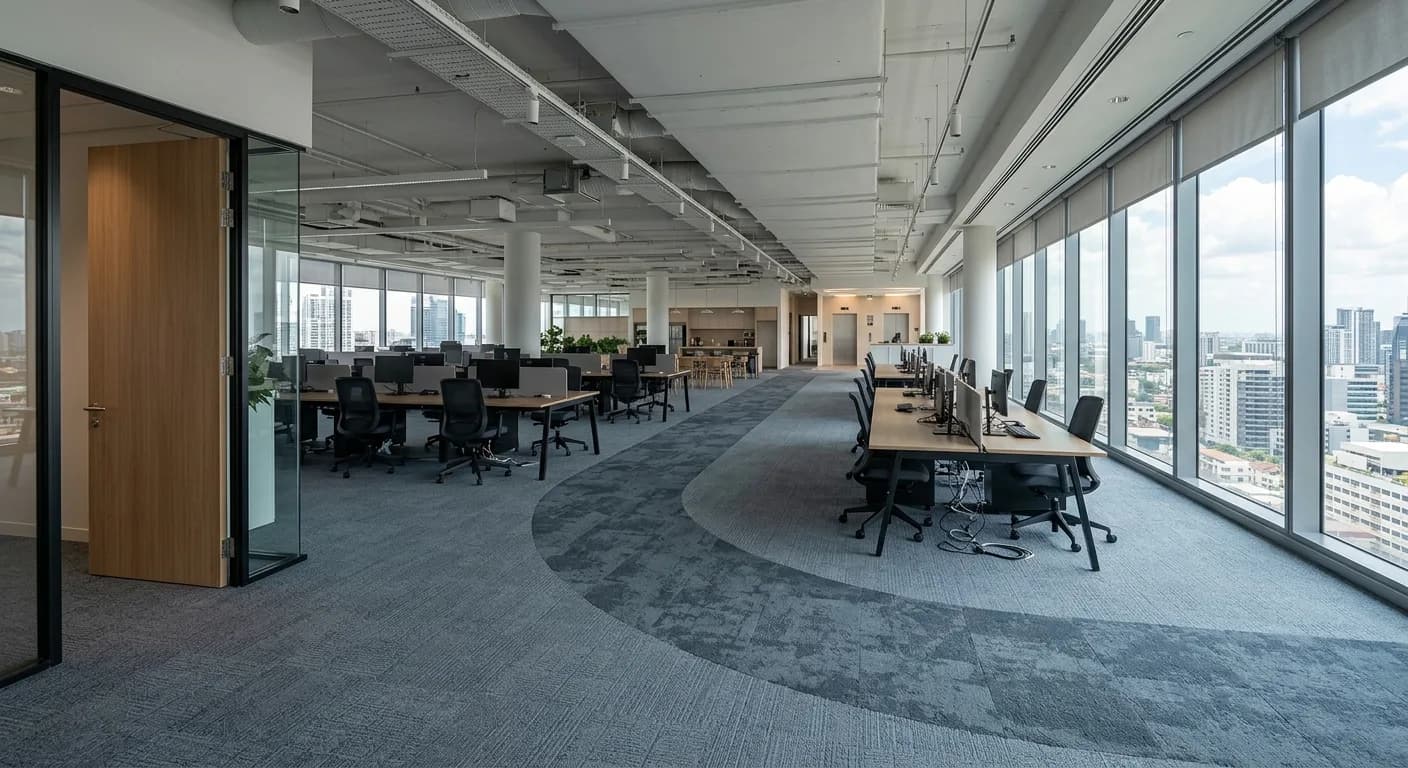
Most commercial carpet quotes are produced from two numbers: square footage and a frequency. That is enough to price a job and nowhere near enough to design a programme, because it treats every square foot as identical when the whole problem is that they are not.
Designing a carpet maintenance programme should ideally start as soon as the carpet is installed. If the carpet is already down — as it usually is — the study still needs doing, and it takes about an hour.
Walk the layout and find the high-traffic areas
Study the building's layout to determine what the high-traffic areas actually are, so those can be tended to daily rather than on the same cycle as everything else. This is not a guess made from the floor plan. Traffic follows doors, lifts, lavatories and the coffee point, and it concentrates into lines that are usually obvious once you look at the pile rather than the room.
Two things fall out of this immediately. The areas that need daily attention are usually a small fraction of the floor, and the areas being cleaned on the same schedule for no reason are usually most of it.
Find the foot-traffic patterns and the loading areas
The layout also tells you where the majority of dirt and soils will be tracked in. Loading areas, service corridors and back-of-house routes bring in a different class of soil from the front door — heavier, oilier, and carried on footwear that has been somewhere industrial.
A programme that treats the loading dock corridor like the executive floor will over-clean one and under-clean the other, and the second mistake is the expensive one.
Find the entryways and plan the matting
Another key reason to study the layout is to determine the entryways and plan a matting system, because that is what prevents the majority of dirt being tracked along the carpet in the first place. Every floor care system starts at the door.
Count the exterior doors. Count the ones with matting. In most buildings those two numbers do not match, and the gap is where the carpet is being lost.
Know what the specification gave you
The comprehensive programme really begins with proper carpet specification: colour, texture, construction and installation appropriate to the environment the carpet will serve. Poorly specified carpeting can make proper maintenance very difficult, and no schedule fully recovers from it.
A specifier should have considered the type and amount of traffic, the surrounding environmental conditions, and the available opportunities for maintenance — alongside decor, style and atmosphere. When you inherit a floor, working out which of those were considered tells you which problems are maintenance problems and which were decided the day the carpet was chosen.
A pale, flat, low-contrast carpet in an entrance lobby off a Florida car park is not going to be rescued by frequency. It is going to need matting, interim cleaning where the traffic is, and a realistic conversation about what "clean" will look like.
Write the replacement cost at the top
It is never a bad idea to keep in mind how much it would cost to replace the carpet. With that dollar figure in front of you and your staff, the motivation to keep the carpet in its best condition is a good deal easier to sustain — and so is the budget conversation.
Carpet is a significant investment, in financial terms and in the overall image of the facility. The people charged with keeping it looking like new are not only preserving the carpet and preventing premature replacement; they are maintaining an impression of the building that every visitor forms in the first ten seconds.
What the study produces
An hour of walking gives you the four things a real programme needs: which zones get daily attention, where soil enters and in what form, whether the matting is adequate, and what the floor you inherited is capable of. Everything after that — method, frequency, budget — follows from those.
We do this walk-through as a consultation and will hand the resulting programme to your own staff to run if that suits you better than us doing the work. See consultation and training, or arrange a site assessment.
Need this handled in your building?
Serving Broward, Miami-Dade and Palm Beach counties.