
School and University Carpet on a Term Calendar
A school has the best cleaning window in commercial property and the worst soil load. Almost everything about the schedule follows from using the first to survive the second.
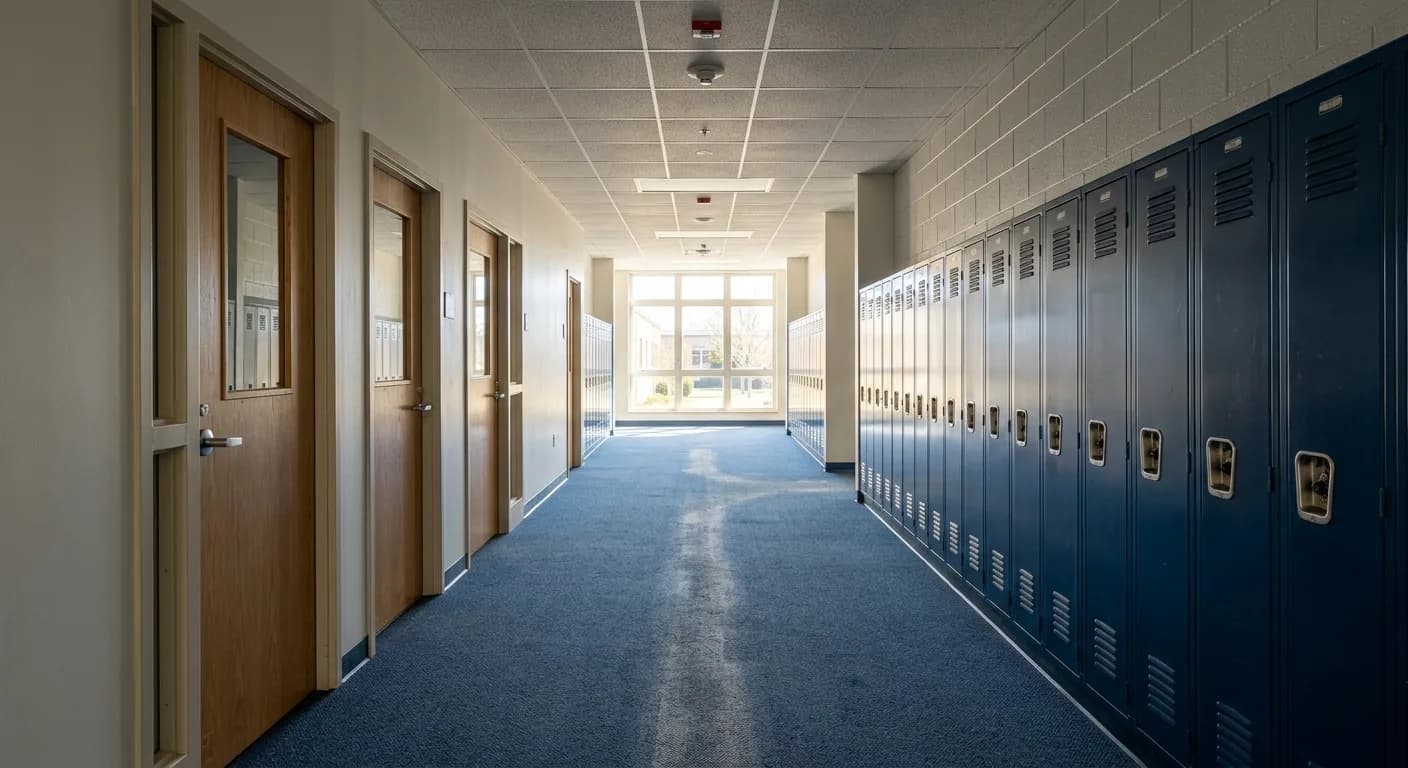
Educational buildings are unusual in commercial property: they get a genuine, predictable, weeks-long closure every year. Almost nothing else does.
They also carry one of the heaviest soil loads of any building type, delivered by people who are not thinking about the floor. The whole of a school's carpet strategy is using the first fact to survive the second.
The summer closure is for restorative work, and only that
Restorative cleaning — hot-water extraction — is the method that needs time. It reaches soil low-moisture methods cannot, and it takes considerably longer to dry.
A summer closure is the one window in the year where that is straightforward, and it should be booked for exactly that. It is not the moment to do everything; it is the moment to do the thing that cannot be done in term time.
The order matters. Vacuum thoroughly first, because vacuuming removes more than 79 per cent of the soil in a carpet and everything left behind turns to mud when solution is applied. Deal with the spots that will not come out in a general clean — coffee, soda, red food dye, food and protein stains, gum, tar and grease — before the machines start. Then extract, groom the pile while it is still damp and warm so the floor is not left striped with wand marks, and dry it fast with air movers.
Protector goes on after that, on the entrances and corridors, because it is what carries those areas through a full academic year.
Term time is interim work, in the gaps
Once term begins the windows shrink to evenings, weekends and half-term. Low-moisture encapsulation dries to the touch in 20 to 60 minutes and returns carpet to light foot traffic in two to four hours, which fits a Friday evening or a Saturday.
Concentrate it where the traffic is rather than spreading it evenly. In a school that means entrance halls, main corridors and the routes between the busiest blocks — a fraction of the floor area carrying most of the wear.
One scheduling detail is worth knowing: encapsulation cures over about 24 hours and the crystallised soil comes out with the next vacuuming, not with our machine. A corridor cleaned on Friday, vacuumed on Monday morning, looks better than one cleaned on Sunday night.
Entrances are the whole argument
Ninety-four per cent of the soil in any facility arrives on foot. In a school that arrives in concentrated bursts — several hundred pairs of shoes crossing the same threshold within a few minutes, several times a day, straight off a playground or a car park.
In South Florida that means quartz sand, and after rain it means sand and water together. Sand is abrasive: it does not merely look dirty in the pile, it grinds against the fibre every time somebody walks on it. A corridor that has gone grey and flat has usually been sanded rather than stained, and no cleaning brings back what has been abraded.
Matting inside and outside every exterior door, vacuumed as part of the daily round and replaced when it stops working, does more for a school's carpet than any increase in cleaning frequency. A mat that is full has stopped collecting and started redistributing.
The weekly routine that keeps it in one piece
Between the interim cleans, three things carry the load. Daily vacuuming with a commercial machine that uses a beater brush, because 80 per cent of what is in the carpet is dry soil. A pile lifter run weekly over the high-traffic areas, which removes embedded sand a vacuum can no longer reach and stands the pile back up. And twice-daily vacuuming at track-off areas and canteen entrances, where the load is heaviest and where grease turns tracked soil into something that no longer vacuums out at all.
Spot response, by people who are already there
A contractor cannot reach a spill in ten minutes and a spill is decided in the first ten minutes. Spot removers remove spots, not stains — and a spot left until the next scheduled clean has become a deep soil that makes the carpet look old.
So the useful investment is a spotting kit kept near where spills happen, with a laminated guide, and staff trained on four steps: blot or vacuum first, work from the outside inwards, never scrub, and apply weight to lift the solution back out. Plus one rule that saves more carpet than any product — a mark that has resisted two correct attempts gets logged, not attacked with something harsher.
Planning a year
The schedule writes itself once the closures are on the page: restorative work in the summer, interim work into half-terms and weekends, weekly pile lifting, daily vacuuming, and immediate spot response all year. What is left is deciding which areas rate as extreme, high, medium or low usage — and in a school that walk takes an hour and saves a great deal of money.
We build these programmes and will hand them to your own staff to run — see consultation and training or arrange a site assessment.
Need this handled in your building?
Serving Broward, Miami-Dade and Palm Beach counties.