
Restorative Cleaning: Judging by Soil, Not by Calendar
Booking deep cleans by date guarantees you are either early or late. Judging by soil level is harder to put in a contract and it is the only thing that works.
Almost every commercial carpet contract books restorative cleaning by date. Twice a year, or quarterly, or annually. It is easy to price, easy to schedule and easy to agree, and it is wrong in both directions at once.
Some floors get a deep clean they did not need, which costs money and puts water into a carpet for no reason. Others get one months after they needed it, by which point the soil has been ground into the base of the pile and what was a clean has become a recovery.
Appearance level is not soil level
The first thing to separate is how a carpet looks from how much soil is in it, because they diverge — and the direction they diverge in depends on the carpet.
A patterned, dark, high-contrast carpet hides soil extremely well. So does wool, which has excellent soil-hiding characteristics and is very often more soiled than it appears. On those floors, waiting until it looks bad means waiting far too long.
A plain, pale, low-contrast carpet does the opposite: it shows every mark and every traffic lane while still being structurally fine. On those floors, cleaning when it looks bad means cleaning too often.
Neither carpet should be scheduled by eye, and neither should be scheduled by date.
What to actually look at
The walk takes fifteen minutes and answers the question properly.
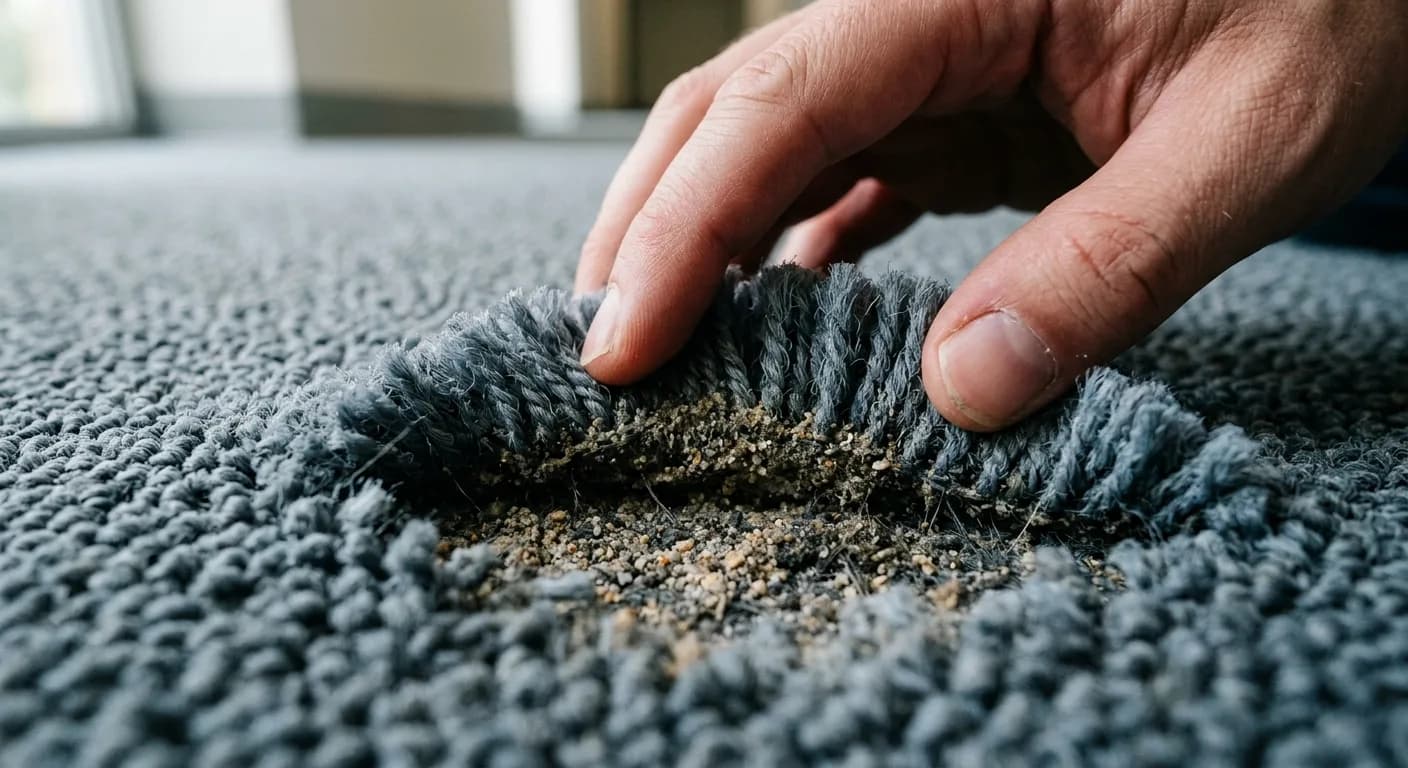
- Part the pile in a traffic lane and look at the base. This is the test that matters. Grit at the base of the pile is the soil that abrades the fibre, and it is invisible from standing height. If it is gritty between the fingers, the floor needs restorative work regardless of how it looks.
- Compare a lane against the carpet under the furniture. The protected area is the reference tone. The size of the gap is how far the floor has drifted.
- Check whether the pile stands up. Crushed, flattened pile in a lane may recover with grooming and pile lifting, or it may be permanent wear. Knowing which decides whether a deep clean will help.
- Look at how quickly the last clean stopped holding. A floor that resoiled within weeks has residue in it, and the answer is a better rinse rather than a more frequent clean.
- Count the spots. Accumulated untreated spots are what make a floor read as old, and they are a spot-response problem, not a restorative one.
The interim work is what buys the interval
The reason restorative cycles can be long is that something else is holding the appearance in between. Appearance-level cleaning exists to maintain an acceptable standard at all times, rather than waiting until the carpet looks bad and then correcting it.
Methods with short drying times — encapsulation, absorbent compound, dry foam — improve appearance substantially without leaving harmful residue, and carpet is back in light foot traffic in two to four hours.
Get that right and restorative cleaning becomes a genuine long-cycle intervention. Get it wrong and you are running deep cleans as maintenance, which is expensive and hard on the carpet.
How to put a judgement call in a contract
The obvious objection is that "when it needs it" cannot be budgeted. That is solvable.
Put restorative cleaning in the programme as a budgeted allowance at roughly the right interval — based on the usage rating of each area — and then confirm or defer each one on inspection. The money is committed, the schedule is provisional, and the decision is made by looking at the floor.
In practice extreme-usage areas such as entrances will take their allowance every time. Low-usage areas will defer more often than not, and the deferred budget is available for the areas that need it.
This also gives the building something useful: a written record of what was inspected and what was decided, which is what answers "why hasn't this been cleaned" in March without starting the conversation from scratch.
When restorative is the wrong answer entirely
Two situations deserve saying out loud before the work rather than after.
Where a traffic lane has been abraded — sanded flat by embedded grit over years — a restorative clean will improve it and will not restore it. That is worth knowing before the invoice.
And where a floor smells rather than looks dirty, the problem is biological and below the surface. More cleaning does not reach it; an enzyme treatment with a proper dwell does, and where contamination has soaked into the cushion, nothing applied to the surface will.
We inspect and advise as part of every programme — see commercial services or consultation and training.
Need this handled in your building?
Serving Broward, Miami-Dade and Palm Beach counties.