Portable or Truck-Mount in a High-Rise
On the twenty-second floor a truck-mount is a hose down a stairwell. The portable is usually the right machine — and it brings a set of problems the truck never had.
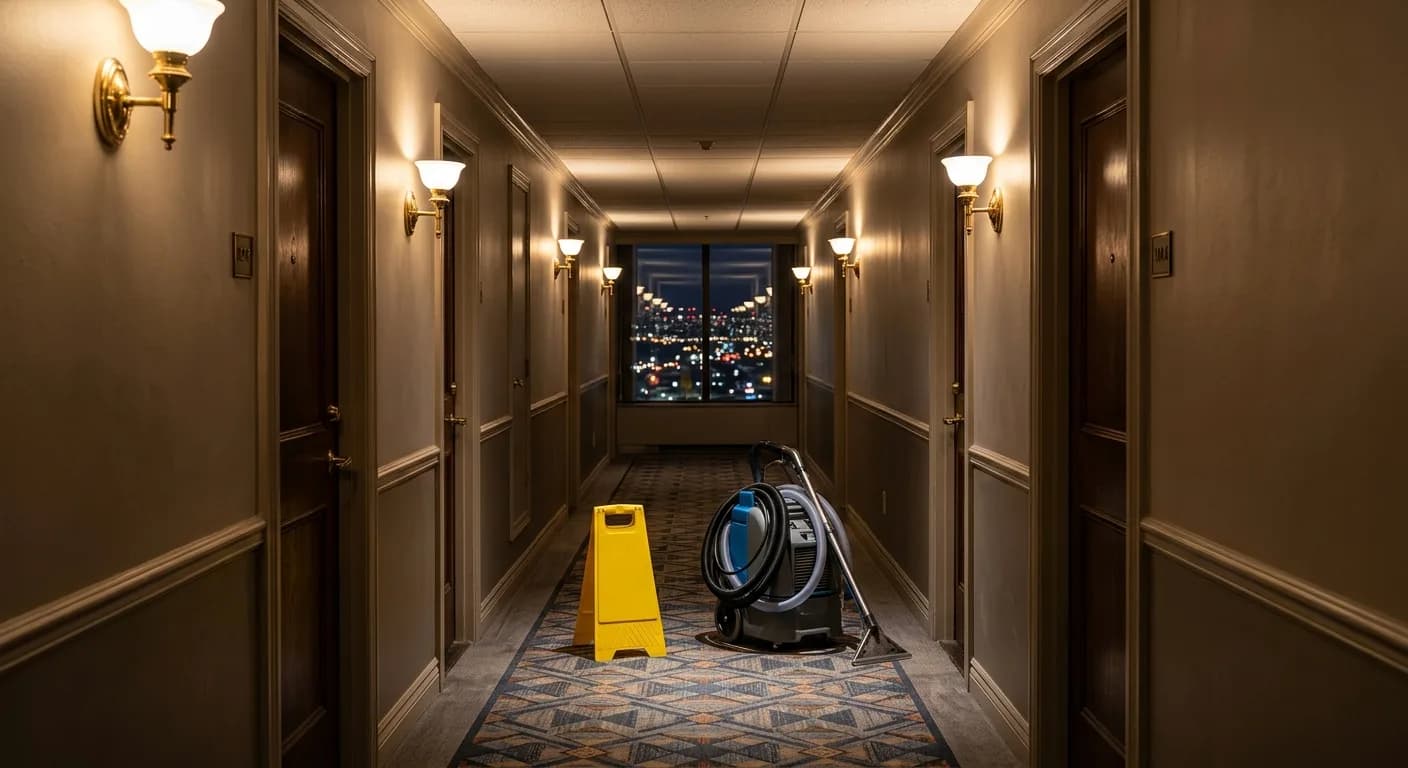
A truck-mounted extractor is more powerful than anything that fits in a lift. It also lives in the car park, connected to the work by a hose, and every floor between the two costs pressure, heat and patience. Somewhere above the first few storeys the arithmetic turns, and in a high-rise condominium or an office tower the portable is usually the machine that should be there.
That decision brings its own set of requirements, and the ones that go wrong are never about suction.
Start with the electricity
Plug the electrical cords into different outlets on separate circuits. A portable extractor runs two vacuum motors and a pressure pump, and putting all of that on one circuit in an older building trips the breaker — usually in the middle of a corridor, at eleven at night, on a circuit that also happens to feed something the building cares about.
Finding two circuits takes five minutes at the start and saves an hour of apologies later.
Safety before anything is switched on
Most carpet cleaners work alone or in small crews, so responsibility for personal safety rests with the individual — and that is doubly true on a public site. Caution signs go out before the work starts, not once there is already a wet floor.
In an occupied building this is not a formality. A residential corridor at night has people in it: dog walkers, shift workers, someone coming back from the gym. A damp carpet with no signage is the most likely incident on any commercial carpet job.
Set-up, in order
- Pre-mix the solution in a bucket of hot water to the manufacturer's dilution ratio, then pour it into the solution tank. Mixing in the bucket rather than the tank is what makes the dilution accurate and stops undissolved product going through the pump.
- Prime the pump. Attach the primer hose to the solution line connector at the front of the machine, put the hose in the tank, and run the water pressure pump for a few minutes to build pressure. Skipping this is how a pump gets run dry.
- Connect the solution line, the vacuum hose and the cleaning wand.
- Switch on the pressure pump and both vacuums.
Running the wand
Glide the wand forward, away from you, holding the lever down; then draw it back toward you. The wand leaves lines in the carpet, and those lines are the point — they are visual guides showing which areas have been cleaned.
In a long corridor under artificial light that is the only reliable way to keep track. It is also why grooming afterwards matters: the same lines that guide the operator read as stripes to a resident the following morning if they are left set into the pile.
The step that decides whether the building complains
Waste water. The soiled water in the waste tank must be disposed of into a sewage drain only — not a storm drain, not a landscape bed, not the car park.
Then rinse the waste tank out with clean water to wash out remaining soil. Skip that and you have a very smelly portable the following day, which in a high-rise means a machine that smells being wheeled through a residential corridor and into a lift.
In practice this is the difference between a contractor a building is happy to have back and one it is not. Everything else about the job is judged on the carpet; this part is judged on the corridor, the lift and the loading bay.
Where the portable is genuinely the better machine
Beyond reach, portables suit the way high-rise work actually happens: a few units at a time, corridors in sections, common areas between resident movements. A truck-mount rewards large uninterrupted areas. A tower does not have any.
The portable also pairs naturally with low-moisture interim work — which in an occupied residential building, where nobody can be asked to stay off a corridor for six hours, is often the correct method anyway.
How we work in towers is set out on our high-rise condominiums page, and the wider programme at commercial services.
Need this handled in your building?
Serving Broward, Miami-Dade and Palm Beach counties.