
One Plan Across Different Floor Surfaces
Most buildings have four or five floor surfaces and four or five arrangements for looking after them. Coordinating the plan is worth more than optimising any one of them.
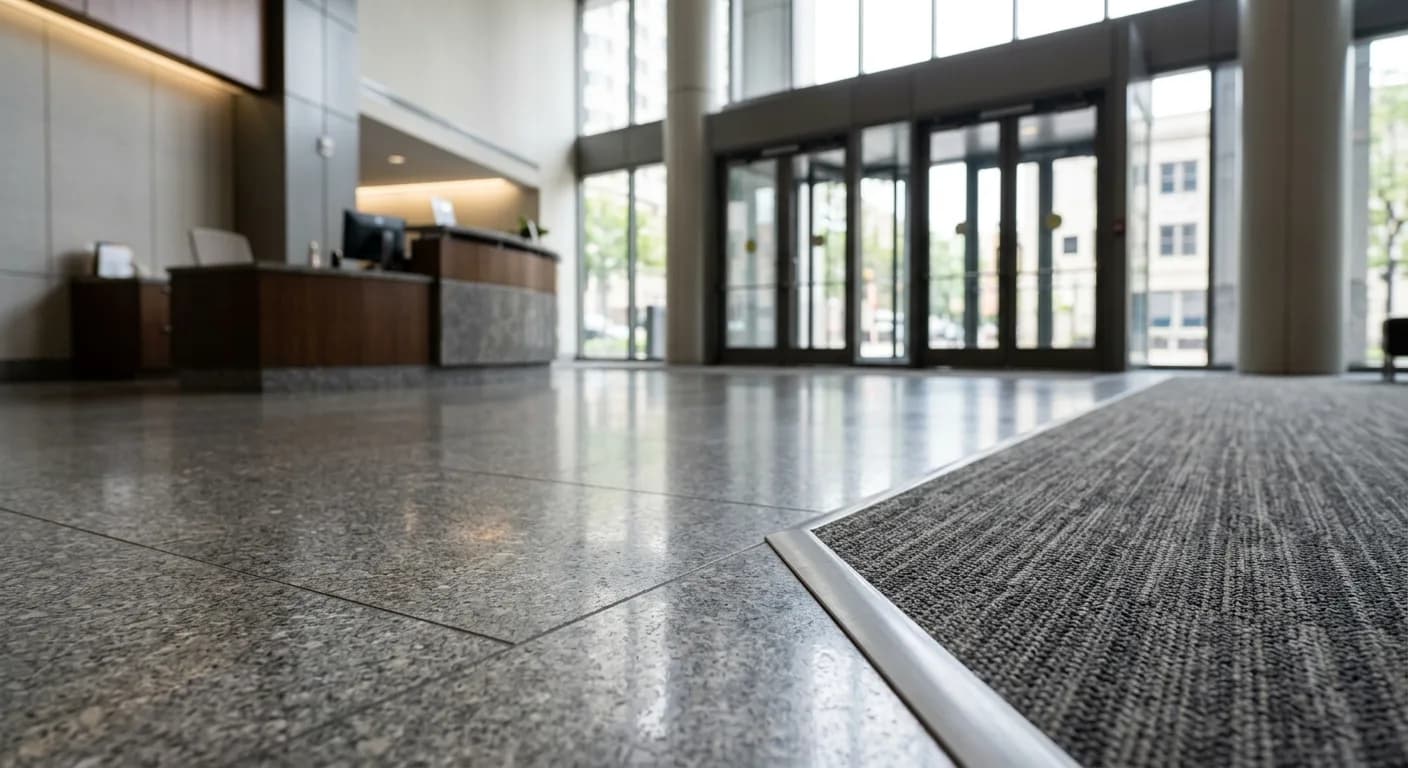
Walk a commercial building and count the floor surfaces. Carpet in the offices and corridors, hard surface in the lobby, something different in the kitchen, matting at the doors, perhaps stone in the entrance.
Now count the arrangements for looking after them. In most buildings it is nearly as many: one contractor here, the janitorial company there, something that happens annually, and one surface nobody has thought about since the building opened.
Each arrangement may be individually sensible. The gaps between them are where the damage happens.
The boundaries are where floors fail
The single most damaged spot in most buildings is where two surfaces meet.
Hard floor to carpet at a lobby edge is where grit gets tracked from one onto the other. A kitchen hard floor to corridor carpet is where grease crosses a threshold and stops being removable by vacuuming. Matting to carpet is where a mat that has stopped working starts redistributing what it collected.
Those transitions belong to nobody in a fragmented arrangement. The hard-floor contractor cleans up to the edge; the carpet contractor starts at the edge; neither owns the two feet in between, which is exactly where the soil concentrates.
Sequence matters more than method
When different surfaces are cleaned by different people on different days, the order is accidental — and the order matters.
Hard surfaces should be done before adjacent carpet, not after, because hard-floor work moves soil and moisture outward onto whatever is next to it. Cleaning the carpet first and the lobby floor the following week means the carpet edge is dirty again immediately.
Matting should be cleaned or replaced before a carpet clean, not after, or the first thing walking onto the fresh carpet is what the old mat was holding.
None of that requires a single contractor. It requires somebody deciding the order, which in a fragmented arrangement nobody does.
Match the method to the space, not the surface
The constraint that shapes commercial floor care is rarely the material. It is the schedule — how long the space can be out of service, when the building is empty, what the traffic is doing.
Which means the useful way to group work is not by surface type but by when it can be done. All the areas available on a Sunday night. All the areas that need the building closed. All the areas that can only be sectioned around live use.
Group the work that way and the plan starts fitting the building rather than the trades.
What to standardise across every surface
Four things, and none of them costs anything:
- The assessment — every area listed with its square footage and a usage rating of extreme, high, medium or low, whatever it is made of. Usage drives frequency on all surfaces.
- The entrances — 94 per cent of soil in any facility walks in through the doors, and matting protects every surface downstream of it at once.
- Spot response — immediate, by the building's own staff, with the right products for each surface and training on where to stop.
- One schedule document — twelve months, every surface on it, so that sequencing is deliberate and the building can see what it has decided.
Where one contractor genuinely helps
Consolidation is not automatically better, and the case for it is not the rate.
It is that the crew that knows the building at eleven at night knows which corridor floods, which lobby edge collects sand, which function room turns over on a Sunday, and what was done to the floor the last three times. That knowledge is what makes the plan work, and it does not survive being split across four suppliers.
The honest counter-case: where a building already has competent people maintaining a surface, replacing them is not an improvement. Training them and writing the specification usually is.
Start with the walk
The plan comes out of walking the property and identifying traffic lanes, entry points, common areas and priority spaces — then grouping the work by surface type and urgency, and deciding whether each grouping is one-off, seasonal or recurring.
That walk takes an hour, and it is the difference between a floor care budget and a floor care plan.
More at commercial floor maintenance, or arrange a site assessment.
Need this handled in your building?
Serving Broward, Miami-Dade and Palm Beach counties.