Insurance, Bonding and Site Safety on a Commercial Job
The paperwork nobody reads until something happens. Here is what licensed, bonded and insured actually means, and the document most buildings should ask for and never do.
Carpet cleaning is an unlicensed trade. Anyone can buy a machine and quote your building, and nothing in the paperwork distinguishes them from a contractor who has been doing it for thirty years.
Which means the paperwork you do ask for carries more weight than usual — and most buildings ask for less of it than they should.
What the three words mean
Licensed means holding the business licences the jurisdiction requires to operate. It is a lower bar than most people assume, because there is no trade licence for carpet cleaning itself.
Bonded means a surety bond exists — a third party that pays out if the contractor fails to meet obligations. It matters most where crews work unsupervised in occupied buildings at night, which is most commercial carpet work.
Insured is the one that actually matters, and it is the one to look at properly. General liability covering damage to your property. Workers' compensation covering the crew — because if a contractor's employee is injured in your building and is not covered, that exposure has a way of finding the building owner.
Ask for certificates rather than assurances, and check that the coverage is current. It is a two-minute request that a competent contractor expects.
The document nobody asks for
Beyond insurance there is a written safety and health programme, and its absence tells you a great deal.
Ours is built to meet or exceed applicable OSHA standards under 29 CFR, along with federal, Florida and local regulation, and it covers the whole scope of what we do: carpet cleaning, upholstery cleaning, the use of extraction equipment, the handling and application of cleaning chemicals, and work at commercial facilities including managed convention centres.
The reason it exists in writing rather than as a set of habits is that large venues ask for it. A managed convention centre or a major hospitality group will require a documented programme before a contractor is allowed on site, and a contractor who has one has already been through that scrutiny.
What a safety programme actually commits to
Four things, and each has a visible consequence on your floor:
- Training — crews trained on the work and on the hazards, which is also what produces consistent results
- Equipment and PPE — provided rather than improvised
- Safety Data Sheets maintained and provided — meaning the building can find out exactly what has been applied to its floor, which matters for occupant queries and for any building certification you hold
- Enforcement — unsafe practice corrected rather than tolerated
The SDS point is the one buildings underuse. If a tenant asks what was used in their space, or if you are pursuing an environmental certification, the answer should be a document rather than a phone call.
On site, it comes down to signage
Most commercial carpet crews work alone or in small groups, which means primary responsibility for safety rests with the individual — and that is especially true on a public site.
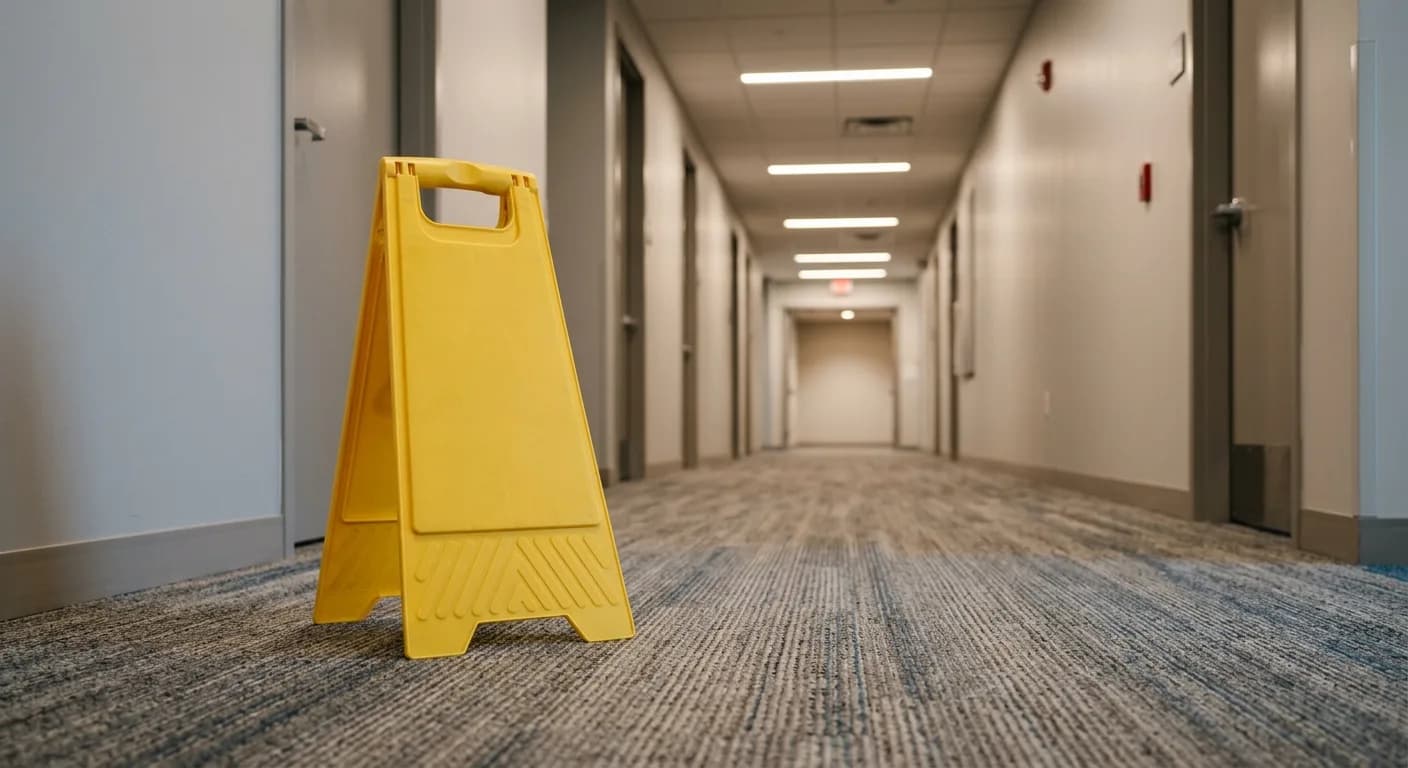
The practical expression of that is simple and non-negotiable: caution signs go out before the work starts, not once there is already a damp floor. In an occupied building this is the most likely incident on the entire job. A residential corridor at midnight still has people in it; a hotel corridor never empties.
If you walk past a crew working in your building with no signage out, that is the thing to raise. It is the most reliable single indicator of how the rest of the job is being run.
What to ask for before the first visit
- Certificates of general liability and workers' compensation, current
- The written safety programme, or confirmation that one exists
- Safety Data Sheets for everything that will be applied in your building
- Confirmation that caution signage is standard practice, not on request
None of it guarantees a good clean. All of it is answerable in a day by a contractor set up properly, and slowly or not at all by one who is not.
More about how we operate at about us, or get in touch.
Need this handled in your building?
Serving Broward, Miami-Dade and Palm Beach counties.