
How to Design a Commercial Carpet Maintenance Program
Most commercial carpet is replaced before it wears out. A maintenance program is what prevents that — specification, the eight factors that set frequency, three levels of cleaning, and the spot procedure that saves a floor.
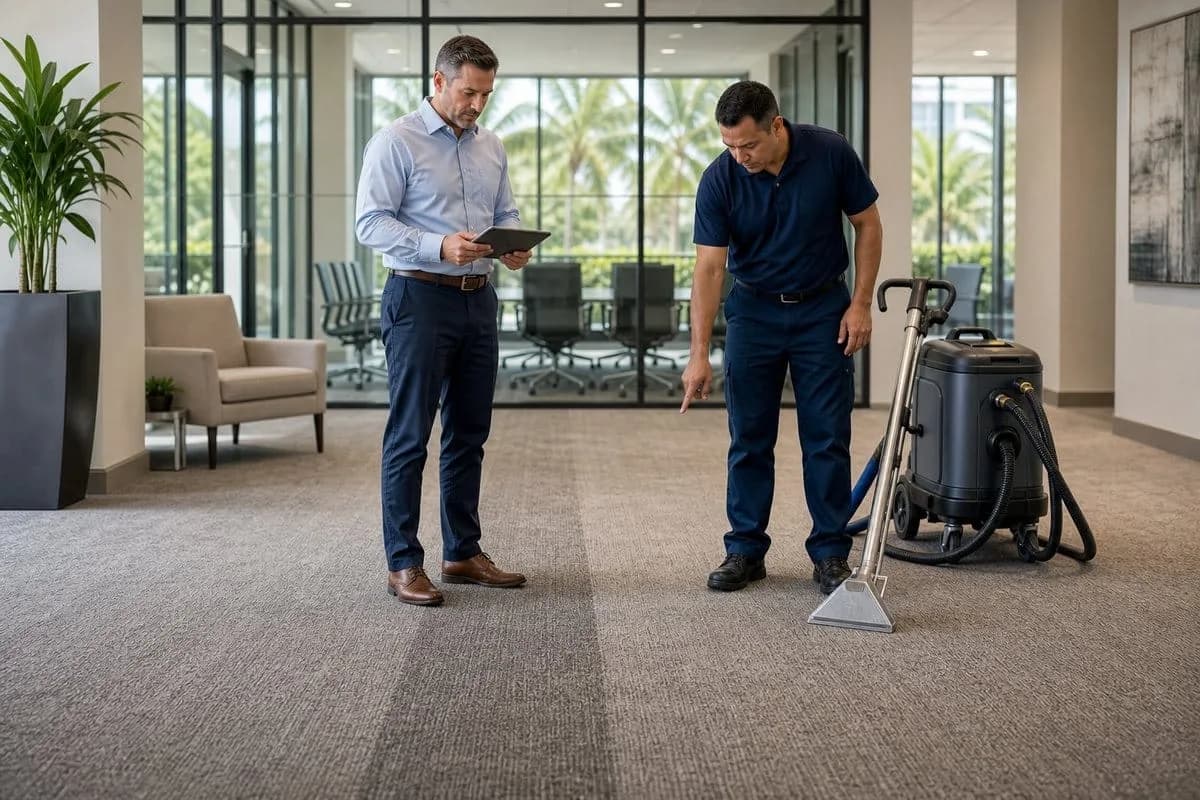
Most commercial carpet is replaced years before it wears out. It is replaced because it looks tired, and it looks tired because nobody wrote down what should happen to it and when. A maintenance program is the difference, and it is cheaper than the carpet.
It starts before anyone cleans anything
A comprehensive program begins at specification. Colour, texture, construction and installation all have to suit the environment the carpet will actually serve — traffic type and volume, the conditions around it, and what opportunities for maintenance the building realistically offers. Poorly specified carpet makes proper maintenance very difficult, and no cleaning schedule fully recovers from it.
If the carpet is already down, this is still worth knowing. It tells you which problems are maintenance problems and which were decided the day the floor was chosen.
Eight things that set the method and the frequency
How a floor should be cleaned, and how often, is not a single answer. It is set by:
- The source, type and amount of soil
- Traffic loads
- Carpet type, pattern and colour
- Indoor environmental quality considerations
- Extending the life of the investment
- Budget
- How much downtime the space can allow
- The image the business wants to project
Two buildings of identical square footage rarely land on the same schedule. An entrance lobby off a beach and a private office on the fourth floor are not the same floor, whatever the specification says.
Carpet is a filter, and filters fill up
Dr Michael Berry, in Cleaning for Health: Protecting the Built Environment, makes the point that matters most to anyone responsible for a building rather than for a floor: carpet acts as a filter or sink in the indoor environment, trapping soils, gases and animal or human dander.
That is useful right up until it is full. An excess build-up of soil in carpet can adversely affect the indoor environment, and soils, volatile organic compounds and biopollutants have to be removed to keep that environment healthy. The practical goals follow from it: maximise the extraction of pollutants from the building envelope, minimise chemical, particle and moisture residue left behind, minimise human exposure, and dispose of cleaning waste properly.
Residue is the part most often skipped. Detergent left in the pile is sticky, and it collects the next fortnight of dry soil faster than the carpet collected the last month of it.
Three levels, and skipping one breaks the other two
1. Daily maintenance
The most important part of carpet care, and the cheapest. Vacuuming removes more than 80 per cent of the soil in a carpet, because more than 80 per cent of it is dry soil.
Every floor care system starts at the door. Industry studies put 94 per cent of the soil in any facility as having been brought in on somebody's feet, which makes matting the building's biggest single line of defence. Walk-off mats belong in the daily vacuuming round like any other surface, and a mat too soiled to work should be cleaned or replaced rather than left down.
Then a plan for spots, because spots do not wait for the schedule.
2. Interim cleaning
Appearance-level cleaning between restorative cycles, concentrated where traffic actually is. Low-moisture encapsulation is the usual method: carpet is back in light foot traffic in two to four hours, which is what makes it possible in a building that cannot close.
3. Restorative cleaning
The deep clean, on a longer cycle judged by soil level rather than by the calendar. Hot-water extraction takes longer to dry and goes correspondingly deeper. A schedule that runs restorative work by date rather than by condition either wastes money or arrives too late.
Spots: the order matters more than the product
When a spill happens, the sequence is what saves the carpet:
- Remove as much soil as possible first, by vacuuming or blotting.
- Work from the outside of the spot inwards, so it is not spread wider.
- Do not scrub. Scrubbing distorts the pile, and a distorted pile catches light differently — the mark stays visible after the stain is gone.
- Apply weight or pressure to lift as much as possible into the towel.
Spots left until the next scheduled clean become deep soil, and deep soil is what makes a carpet look old enough to replace.
Keep the replacement cost in front of you
The most useful number in any maintenance discussion is what the carpet would cost to replace. Put that figure at the top of the program. It is the honest measure of what the vacuuming, the matting and the interim cleaning are actually protecting, and it is usually the moment a maintenance budget stops looking expensive.
We write these programs for buildings across Broward, Miami-Dade and Palm Beach, and we will hand the whole thing over for your staff to run if that suits you better than us doing the work. Our commercial carpet maintenance guide sets out the service protocols in full, and there is more on how we work on our consultation and training page.
Need this handled in your building?
Serving Broward, Miami-Dade and Palm Beach counties.