Handing the Programme to Your Own Team
The best outcome for most buildings is not a bigger contract. It is a maintenance system their own staff can run — and that survives the person who learned it leaving.
Most of what determines a commercial carpet's life happens when no contractor is in the building. Vacuuming, matting, and the ten minutes after a spill account for the overwhelming majority of the outcome, and all three are done by people who work for the building.
Which means the most valuable thing we can hand over is often not a service. It is a system.
What a handover actually contains
We provide several levels of service, and the most useful for many buildings is the one where we write the programme and train the people who will run it. That means working hands-on with facilities staff — going over spotting and cleaning techniques with the personnel who will actually do it, in the building where they will do it.
A complete handover contains four things:
- A zoned schedule. Every area with a usage rating of extreme, high, medium or low, and what happens to it how often — daily vacuuming, weekly pile lifting on the lanes, twice-daily attention at track-off areas and kitchen entrances.
- Equipment recommendations, and the equipment. Which vacuum, which pile lifter, which spotter. We sell equipment for specific cleaning situations, and the recommendation comes from having used the alternatives.
- Spot response training. The four steps, the wool exception, and the rule about when to stop and log rather than escalate.
- Written procedures that describe what to do rather than assuming knowledge.
The requirement nobody specifies: surviving turnover
Here is the thing that decides whether a handover works, and it has nothing to do with the quality of the training.
Facilities teams change. The supervisor who spent an afternoon learning the programme moves on, and the person replacing them was not there. If the system lived in that person's head, it leaves with them — and eighteen months later the building is back where it started, wondering why the carpet has declined.
So the system has to be simple enough to survive that. Simplicity is the design constraint, not a nice-to-have: a programme that continues working when management or staff change on site is a different thing from one that works while the trained person is still there.
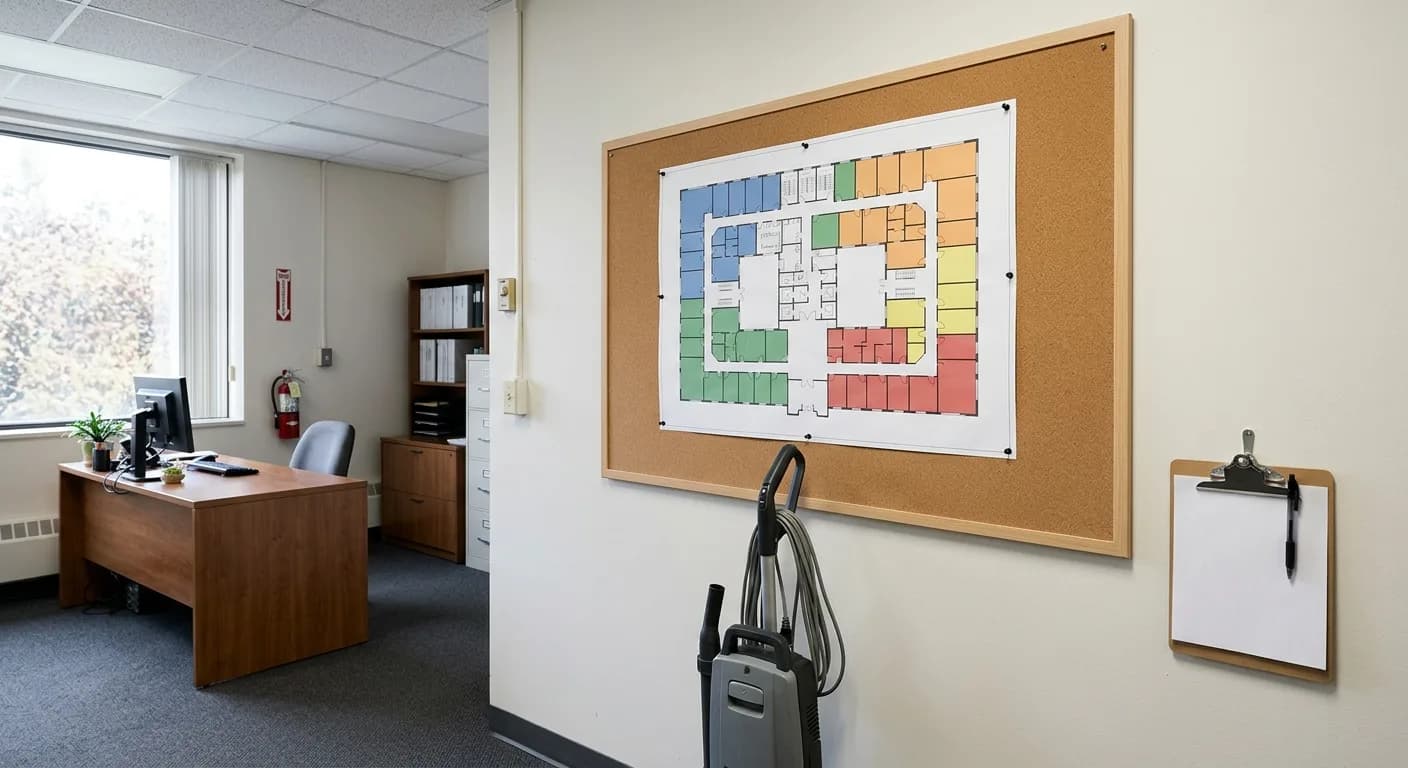
In practice that means few rules rather than complete ones. Four spot-cleaning steps, not nine. One broad spotter plus a laminated guide, not a shelf of products requiring correct identification. A zone map on a wall, not a manual in a drawer. Each of those survives a handover between two people who never met.
Where a contractor still belongs
Handing over daily maintenance does not mean handing over everything. Three things stay:
Restorative cleaning, which needs equipment, chemistry and the judgement to run it — including the pH control that protects wool and the neutralising rinse that stops a floor resoiling.
Interim cleaning at whatever frequency the zones require, which is usually more machine time than a building wants to own.
Inspection. Someone from outside looking at the floor periodically and saying whether the programme is holding — which is also when restorative work gets confirmed or deferred, because that call should be made by looking at the carpet rather than at the calendar.
That combination is the most common arrangement we end up in, and usually the best value: the building does what only it can do quickly, and we do what needs equipment and certification.
The case for doing it this way
It costs a building less than a full-service contract, and it produces a better floor — because the work that matters most is the work that has to be immediate, and immediacy is something only the building has.
It also produces a building that understands its own floors. A facility manager who knows why the entrance is the priority, what the vacuuming is actually removing, and when to stop working at a stain is a better customer for the remaining contracted work — and considerably harder to sell something unnecessary.
See consultation and training, or arrange a site assessment to start with the walk.
Need this handled in your building?
Serving Broward, Miami-Dade and Palm Beach counties.