Fitness Centres and Gyms: Sweat, Rubber and Odour
A gym’s carpet problem is not dirt, it is biology. Which is why cleaning it more often does not fix the smell, and why the fix takes five minutes of doing nothing.
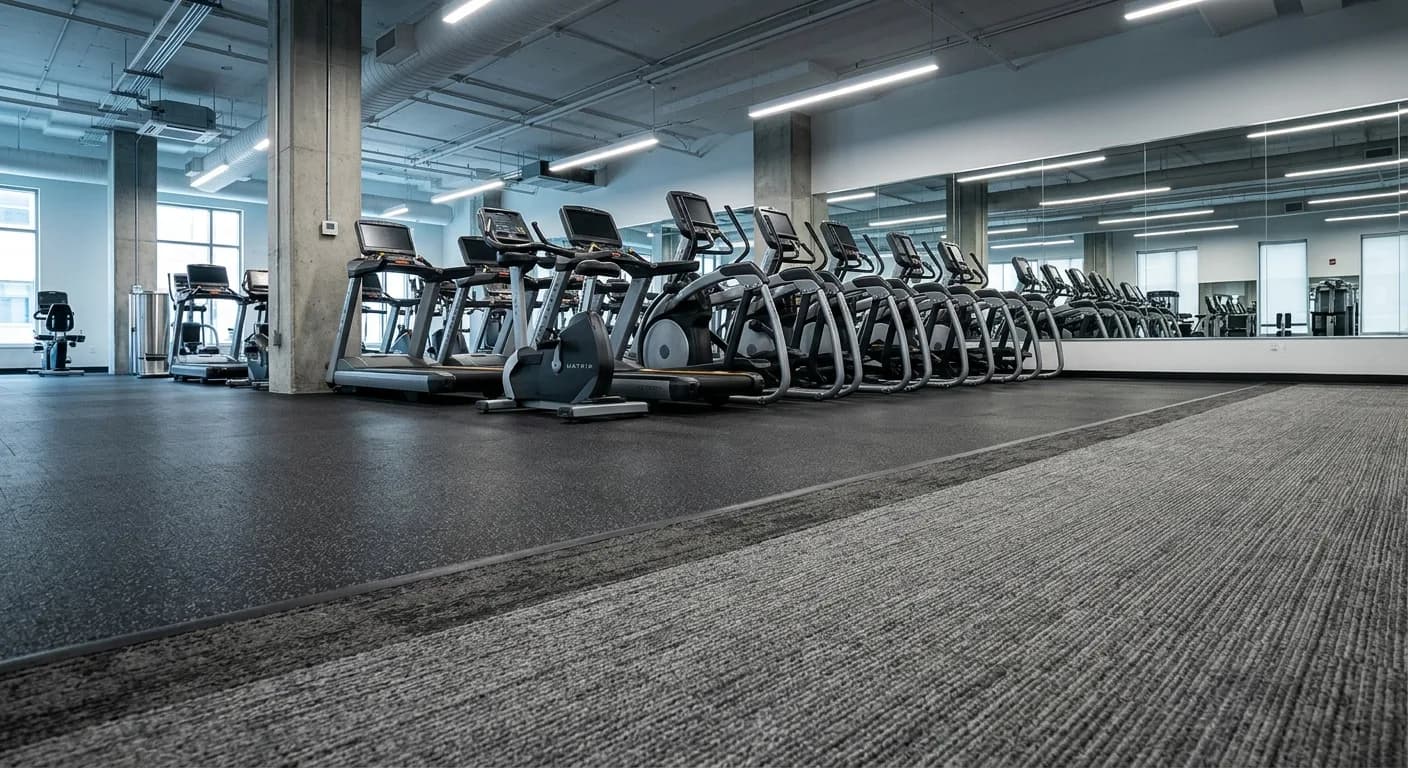
Fitness centres are one of the few commercial environments where the carpet complaint is usually not about how it looks. It is about how it smells — and that is a different problem with a different solution.
Cleaning removes marks. It does not reliably remove odours, because an odour is not material sitting on the fibre. It is the by-product of something biological still active in the carpet, usually below the surface. Wash the surface and the source stays, keeps working, and the smell returns within a week.
The load is protein, continuously
What goes into a gym carpet is sweat, skin, and everything else biological that a room full of exercising people produces, delivered steadily rather than in incidents.
That is protein soil, and protein is the category that resists ordinary cleaning, keeps producing odour, and comes back after the carpet dries. There is no spill to respond to and no mark to treat — which is exactly why it is left until it announces itself.
Rubber compounds the problem. Matting, flooring and equipment feet transfer plasticiser and rubber residue onto adjacent carpet, and like grease it is not water soluble and not removed by vacuuming. It binds dry soil to the fibre, so the carpet stops cycling and starts accumulating.
Enzymes digest rather than lift
An enzyme pre-spray works differently from a detergent. A detergent lifts and suspends soil so it can be rinsed away. An enzyme breaks it down into something that is no longer the original substance.
On the two soils that dominate a fitness floor that is exactly right: grease and oils dissolve in minutes, and protein soils are digested and readied for complete removal by the cleaning that follows.
That is the mechanism that reaches an odour source. It is not a stronger clean; it is a different chemistry aimed at the thing actually producing the smell.
Five minutes of doing nothing
Enzymes work by chemical reaction, which means they need contact time. The product goes on lightly over the soiled areas and dwells for five minutes before the proper cleaning procedure follows.
That dwell is the step that gets cut when the schedule is tight, and cutting it is the difference between a treatment and a rinse. Extract after ninety seconds and nothing has been digested — the floor is cleaned by mechanical action alone, the source survives, and the smell comes back.
Applied lightly, too. Flooding a contaminated area drives contamination deeper into the backing and the cushion, where nothing applied to the surface can reach it. Treating an odour with enthusiasm and a lot of water is how a localised problem becomes a large faint one.
Zone the floor around the equipment
Fitness floors do not soil evenly:
- Around cardio equipment — the heaviest protein load in the building, concentrated in small areas under and behind each machine
- Free weight and stretching areas — direct contact with the floor, and the areas most likely to be noticed
- The transition where rubber flooring meets carpet — where residue transfers and where the two surfaces trap soil between them
- Circulation and reception — ordinary traffic soil, from outside
The first three need enzyme treatment as a routine step rather than an occasional rescue. The fourth needs matting and vacuuming like any other entrance.
Ventilation is part of the answer
Everything above assumes the carpet dries quickly. In a warm, humid, heavily occupied room that is not automatic, and damp carpet with a biological load is the worst possible combination.
So methods are chosen by dry time — low-moisture work returns carpet to light foot traffic in two to four hours — and drying is forced with air movers and the building's air handling rather than left to the room.
The honest limit
Enzymes treat what they can reach. Where contamination has soaked through the backing into the cushion, no surface treatment reaches the source and the answer is replacing the affected cushion rather than cleaning the carpet again.
The test is simple: if the smell returns after a correct enzyme treatment with a full dwell, the source is below what any cleaning method can touch. A contractor who says that is worth more than one who sells a fourth clean.
More at commercial property and on biological work at odour and stain treatment.
Need this handled in your building?
Serving Broward, Miami-Dade and Palm Beach counties.