Dry Soil Is 80% of the Problem, and Vacuuming Misses It
Four fifths of what is in a commercial carpet is dry soil, and an ordinary vacuum stops reaching it long before it stops picking things up. That gap is where carpets are lost.
There is one number worth knowing before any conversation about commercial carpet cleaning, and it is this: dry soil makes up about 80 per cent of the total soil in a carpet. Not grease, not spills, not anything a chemical is required for. Sand, grit and dust, walked in and worked down.
That figure has an uncomfortable implication. If four fifths of the problem is dry, then four fifths of the solution is mechanical, and it happens before any cleaning solution is mixed. Add solution to a carpet still full of dry soil and you are not cleaning it — you are making mud.
Where vacuuming stops
Vacuuming removes more than 79 per cent of the soil in a carpet, which sounds like the problem solved. It is not, because a vacuum reaches the soil that is still loose. Commercial pile is dense and tight by design, and once grit has been walked down to the base of it, an upright passing over the top no longer has any mechanical relationship with the material that is doing the damage.
That embedded grit is abrasive. Every footfall grinds it against the fibre, and the result is not dirt — it is wear. A traffic lane that looks grey and flat has usually not been stained. It has been sanded.
In South Florida this happens faster than the industry averages assume, because the soil arriving at the door is quartz sand. It is hard, it is angular, and it is carried in on every pair of shoes from every car park within a mile of the beach.
What a pile lifter does that a vacuum cannot
A pile lifter is the machine for that gap. Between cleanings, regular use removes deeply embedded dry sand and soil, stands the pile back up, and renews the appearance of high-traffic areas — traffic funnel zones, lift lobbies, entrance runs.
Used before a clean it does something else: it opens the pile so the cleaning process can actually reach into it, which makes everything downstream more effective. Pile lifting then a thorough vacuum, and only then the clean.
The operation is simple enough that a building's own staff can run it. Observe the natural lay of the pile first and, where possible, align the machine so the pile lies facing away from the operator — that way the pile is raised on the backward stroke rather than flattened further. Two steps forward, lift the handle, two steps back. A single pass forward and back is generally enough for most carpets. Align the next pass parallel to the first and overlap it, and repeat until the width of the area is covered.
Two maintenance habits decide whether the machine keeps working: check the inner bag frequently and change it once it is half full, because a fuller bag means a weaker vacuum, and clean the sand trap regularly. In a coastal building the sand trap is not an incidental detail — it is the evidence of what the machine is removing.
Where it pays for itself first
Not everywhere. The value is concentrated exactly where the soil is, which in almost every commercial building means:
- Entrance runs, the first ten to fifteen feet inside every exterior door
- Traffic funnel zones, where a wide space narrows and everybody walks the same line
- Lift lobbies, where people stand, turn and grind on the spot
Those areas are a small fraction of a floor's square footage and they carry most of its wear. Treating them on a short cycle while the open areas run on a long one is not cutting corners; it is spending the budget where the damage is.
Which is really an argument about matting
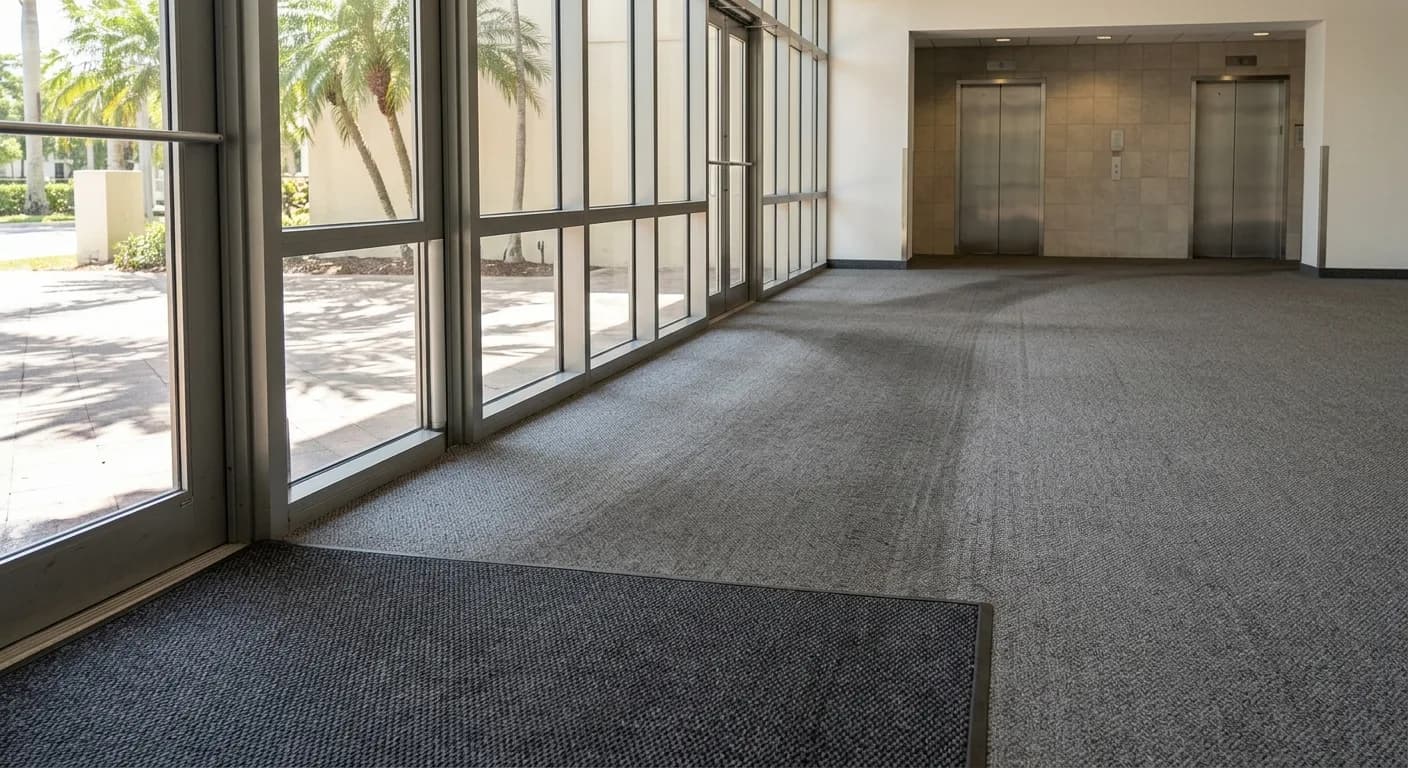
The cheapest version of all of this is stopping the sand at the door. Industry studies put 94 per cent of the soil in any facility as having been brought in on somebody's feet, which makes walk-off matting the single biggest line of defence a building has. Mats belong in the daily vacuuming round like any other surface, and a mat too soiled to keep working should be cleaned or replaced rather than left down to redistribute what it has already collected.
Matting, vacuuming, pile lifting. None of it is glamorous, none of it needs a technician, and together it is most of what determines whether the carpet is replaced in year eight or year fifteen.
The matting, vacuuming and pile-lifting routine is set out in our commercial carpet maintenance guide, and we will train your own staff to run it — see consultation and training.
Need this handled in your building?
Serving Broward, Miami-Dade and Palm Beach counties.