Condo and HOA Carpet: Who Pays for What
In a condominium the carpet that fails first is the carpet nobody owns. Getting the maintenance approved is usually harder than doing it.
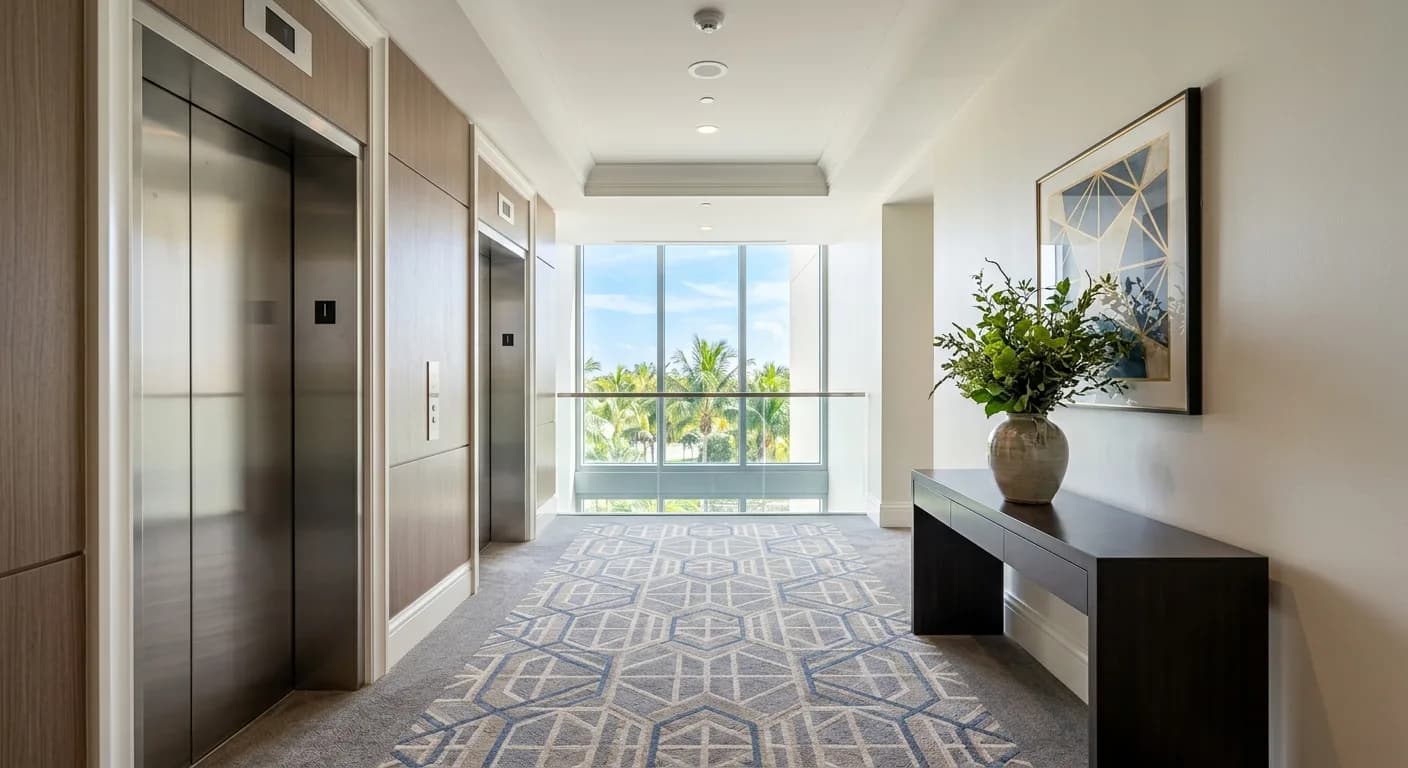
High-rise condominiums are one of the property types we work in constantly, and they have a problem no office building has: the carpet in the corridors belongs to everybody, which in practice means it belongs to nobody until it is bad enough to be an agenda item.
By then the conversation is about replacement rather than maintenance, and replacement is roughly an order of magnitude more expensive.
The common areas are the whole job
Association responsibility usually covers corridors, lift lobbies, stairwells, the main lobby and the amenity spaces — the club room, the gym, the card room, the party room. Unit interiors are the owner's.
That division is worth being explicit about in the maintenance programme, because it decides what gets scheduled and what does not. It also creates the one thing worth offering residents: a unit rate for owners who want their own carpet done while a crew is already in the building. It costs the association nothing and removes the most common complaint about common-area work, which is that people are being disturbed for something that is not theirs.
Amenity spaces are not corridors
The soil profile in a condominium is not uniform. Corridors get luggage wheels, trolleys and continuous foot traffic. The gym gets a protein and moisture load that produces odour rather than marks. The party room gets food and drink in concentrated bursts. The lobby gets everything that arrives from outside, including sand and rain.
Those want different frequencies and, in the gym's case, a different chemistry — an enzyme pre-spray digests protein and grease at the source, which ordinary cleaning does not, and it is the difference between removing a smell and postponing it.
Scheduling around people who live there
The constraint in a residential tower is not commercial hours; it is that the building is occupied at every hour, and the occupants are not customers passing through — they are residents who will remember.
Practically that means working floor by floor rather than tower-wide, keeping one side of a corridor passable, and choosing methods by dry time rather than by depth. Low-moisture encapsulation returns carpet to light foot traffic in two to four hours, and dries to the touch in 20 to 60 minutes. That is a method a resident can walk past. Six hours of drying in a corridor with one lift is not.
Equipment choice follows the same logic. Above a few floors a truck-mount is a hose down a stairwell, so a portable extractor is usually the right machine — and its waste tank must be emptied to a sewage drain and rinsed out, or the following day it is a machine that smells being wheeled through a residential corridor.
Caution signs go out before the work starts. A damp corridor at night in a building full of dog walkers is the most likely incident on the job.
What a board can actually approve
The reason condominium carpet gets deferred is rarely that the board disagrees. It is that "we should clean the carpets" is not a proposal.
What passes is a written programme: each common area listed separately with its own square footage and usage rating, the services against each — interim cleans, restorative cleans, protector, spot response — with an annual count, a rate, an annual total, and an equal monthly payment.
Equal monthly billing matters more here than anywhere else, because association budgets are annual and fixed while carpet work is seasonal and lumpy. A predictable line gets approved; an unpredictable one gets deferred to next year, twice.
And the figure to put at the top of the document is what the corridor carpet would cost to replace. That single number is what turns a maintenance programme from a cost into an alternative to a special assessment.
Restoration first, if the floor has gone
Where corridors have already been let go, an initial restoration clean brings the carpet back to its best achievable condition — quoted and paid separately from the ongoing programme, because it is a one-off recovery rather than part of the running cost.
Keeping those two figures apart is what stops the maintenance programme looking expensive at renewal, when the restoration is not needed again.
More on tower work at high-rise condominiums and property management companies.
Need this handled in your building?
Serving Broward, Miami-Dade and Palm Beach counties.