
Cimex Counter-Rotating Brush Cleaning, Step by Step
The Cimex is a three-head counter-rotating machine, and the counter-rotation is the whole point. Here is how we set it up, dilute for it, and run it — including the recurring-spill routine.
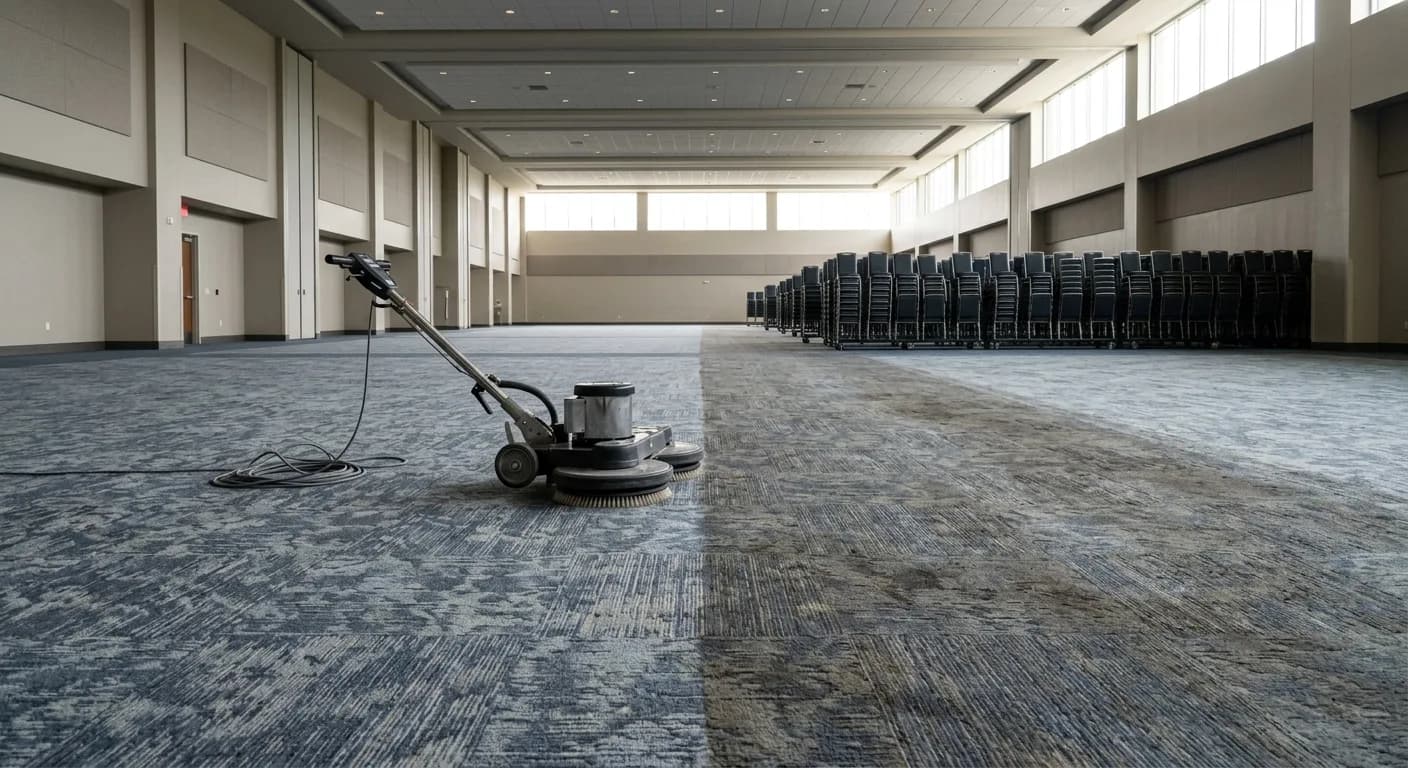
Most floor machines spin one head in one direction. That single rotation fights the operator with a constant slide, and on a long corridor it is exhausting to control. The Cimex uses three counter-rotating heads instead, and that difference is not a specification detail — it changes both the cleaning action and how straight the machine tracks.
Set-up
Mix the encapsulation cleaner to the directions on the container: 4 ounces per gallon of hot water, or 8 ounces for extra-heavy soil. Any temperature works, but hot water produces much better results, and a portable bucket heater is the practical way to get it hot on site.
The Cimex holds 6.6 gallons. We rarely put more than 5 in it, because the remaining space is what stops the solution sloshing as the machine moves.
Install the pad drivers and the pads. The pads do two jobs at once — they provide the correct degree of agitation and they dispense solution to the fibre very evenly, which is harder to achieve with a sprayer alone. Pads stay in service until they wear to about a quarter of an inch, roughly 10,000 square feet, then get replaced. There is generally no need to rinse them between uses.
The power switch is a clockwise rotary. Each time the machine is switched on it reverses direction, which stops brushes setting in one direction and going useless in a short time. That feature is for brushes, not pads — with pads on, switch on and start cleaning.
Two small habits that save money: lift the head slightly off the carpet at start-up to prolong belt life, and if an extension cord is needed, use a heavy-duty 12-gauge cord no longer than 50 feet.
Running the machine
Push the Cimex in a straight line with the wheels rolling. It moves like a lawn mower rather than something being wrestled — the counter-rotating system gives a torqueless cleaning action, which is what makes greater operational control possible over a long shift.
The technique is two passes at two speeds. Walk at a quick pace for a wet pass with the valve held wide open, then follow directly with a dry pass at a slower walk, tapping the trigger every few steps if the floor needs a touch more solution.
Do not over-wet the fibre. More solution is not better. Use just enough encapsulation cleaner to clean properly, because everything beyond that is dry time you did not need to spend and residue you will have to lift out later.
Where a carpet is heavily soiled, pre-spray with the same encapsulation cleaner first, mixed to the container directions and applied evenly with an electric or pump-up sprayer. Do not pre-spray with a different product: foreign chemistry fouls up the crystallisation, and crystallisation is the entire mechanism the clean depends on.
The spot that keeps coming back
Recurring spill stains — the ones that reappear a few days after every clean — get their own routine, and the first instruction is counter-intuitive.
- Do not wet the spill stain. Mix the encapsulation cleaner at twice strength, isolate the stain, and spray around the spot rather than on it.
- Criss-cross the scrubber back and forth over the stain for a full minute or two. Do not apply detergent to the stain itself — the pads pick up moisture from the encapsulation cleaner sprayed around it. This is extremely aggressive low-moisture cleaning.
- Now mix the encapsulation cleaner at twice strength, fifty-fifty, and spray a few good mists directly onto the stain.
- Run the machine over the spot once more to work the solution down into the fibre.
The reason a recurring spot recurs is almost always wicking: contamination sitting below the surface travels back up as the carpet dries. Flooding it wets the contamination and brings more of it up. Working from the outside in, with as little moisture as the job allows, is what breaks that cycle.
Then let it work
After agitation the solution dries in 20 to 60 minutes depending on conditions, and cures over about 24 hours into a crystallised residue that suspends the soil. That soil comes out with dry vacuuming, using high-efficiency collection and filtration so nothing is redistributed into the air. Routine vacuuming keeps lifting crystallised soil after we have left, which is what keeps the floor looking cleaner for longer.
Where this method fits in a wider schedule is set out on commercial services, and the low-moisture case is on our low-moisture cleaning page.
Need this handled in your building?
Serving Broward, Miami-Dade and Palm Beach counties.