Carpet Protector After Cleaning: When It Pays for Itself
Protector is the line most often cut from a commercial quote, and the one with the clearest arithmetic behind it. Whether it is worth buying depends on one thing.
Fibre protector is the first line struck from most commercial carpet quotes. It looks like an add-on, it is quoted per square foot, and the carpet appears perfectly clean without it. The case for it is not sentiment about protecting an investment — it is arithmetic, and it turns on how often the floor gets cleaned.
It is not a coating, it is the factory finish
The common assumption is that protector is a sealant sprayed over clean carpet. It is closer to a replacement part.
Most commercial nylon leaves the mill already treated for stain resistance. That treatment is consumed — by traffic, by soil, by the cleaning that removes the soil. A five-year-old carpet that has been cleaned several times has substantially less of it than the specification promised, and nothing about the carpet announces when it ran out.
Unlike many branded protectors, the product we apply contains all of the same treatments that carpet mills use to protect new stain-resistant carpet. So the honest description is not "adding protection" but restoring the protection the carpet was specified with.
What that protection does in practice is resist both water-based and oil-based soiling. The second matters more than people expect in commercial buildings — food, cosmetics, ink and the oils carried in on shoes are what turn a traffic lane permanently grey.
The two numbers that decide it
Coverage: up to 2,400 square feet per concentrated gallon. That is what makes the line item small relative to the clean it follows. Protector is not a second cleaning; it is a light application over an area that has just been paid for.
Water: 50 per cent of what conventional protectors need. The formulation requires only half the water to apply, which makes it a low-moisture application with correspondingly faster drying.
The second number is the one that decides whether protector is possible at all in a working building. A protector that needs as much water as the clean did adds hours to the downtime, and in a corridor, a lobby or a function room that ends the conversation. Halving it keeps the application inside the window the building already agreed to.
Where it pays, and where it does not
Protector earns its money where soil arrives fastest and cleaning is most frequent — the same short list every time:
- Entrance runs and the first fifteen feet inside exterior doors
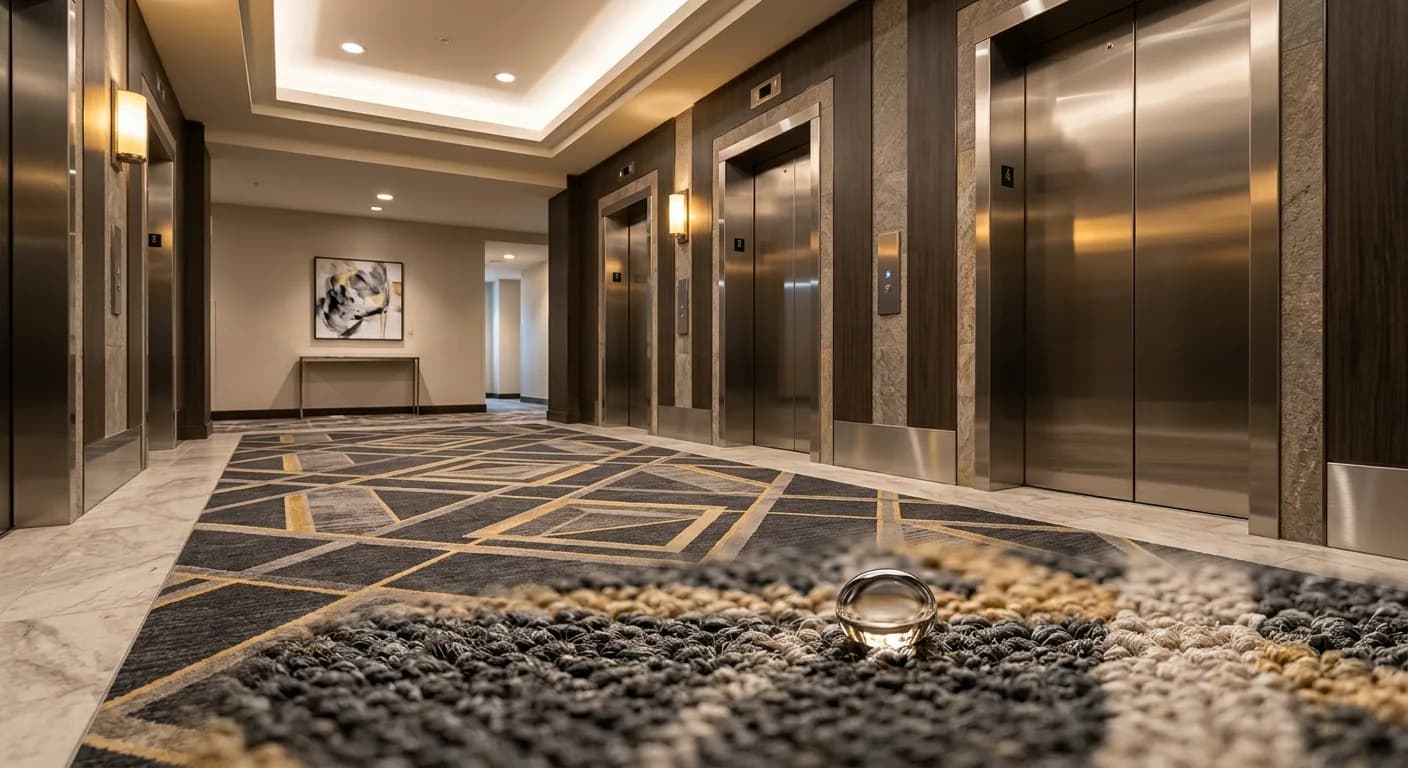
- Lift lobbies and traffic funnel zones
- Food service areas and anywhere drinks are carried
- Wool and other high-value floors, where the replacement cost makes the arithmetic obvious
It pays much less on a lightly used floor cleaned once a year, where the finish has not been consumed and the soil load is low. Applying it uniformly across a whole building is how a reasonable measure becomes an expensive one.
The timing is not negotiable
Protector goes on after the clean and after grooming — grooming sets the pile and prepares the carpet to receive it. Applied over a carpet that has not been properly rinsed, it locks in residue rather than repelling soil, which is worse than not applying it at all.
Which is the honest caveat: protector is only as good as the clean underneath it. It is not a way to make a mediocre clean last longer, and a contractor selling it as one is selling the wrong thing.
How to decide
Ask how many times a year the area is cleaned. Once — probably skip it outside the entrances. Three or four times, or on a maintenance programme with interim work between restorative cleans — it belongs in the specification, applied to the zones that need it rather than to the floor plate.
On an ongoing programme there is a further option: an encapsulation cleaner with the protector built in, which gives enhanced soil resistance and replenishes stain resistance in the same pass as the interim clean.
Which zones justify it is part of a site assessment — see commercial services or arrange one.
Need this handled in your building?
Serving Broward, Miami-Dade and Palm Beach counties.