Bonnet, Brush Pro, Pro Caps or Cimex: What Changes
Four machines, four procedure documents, and only one step that differs between them. Which machine belongs on your floor is a question about the space, not about the chemistry.
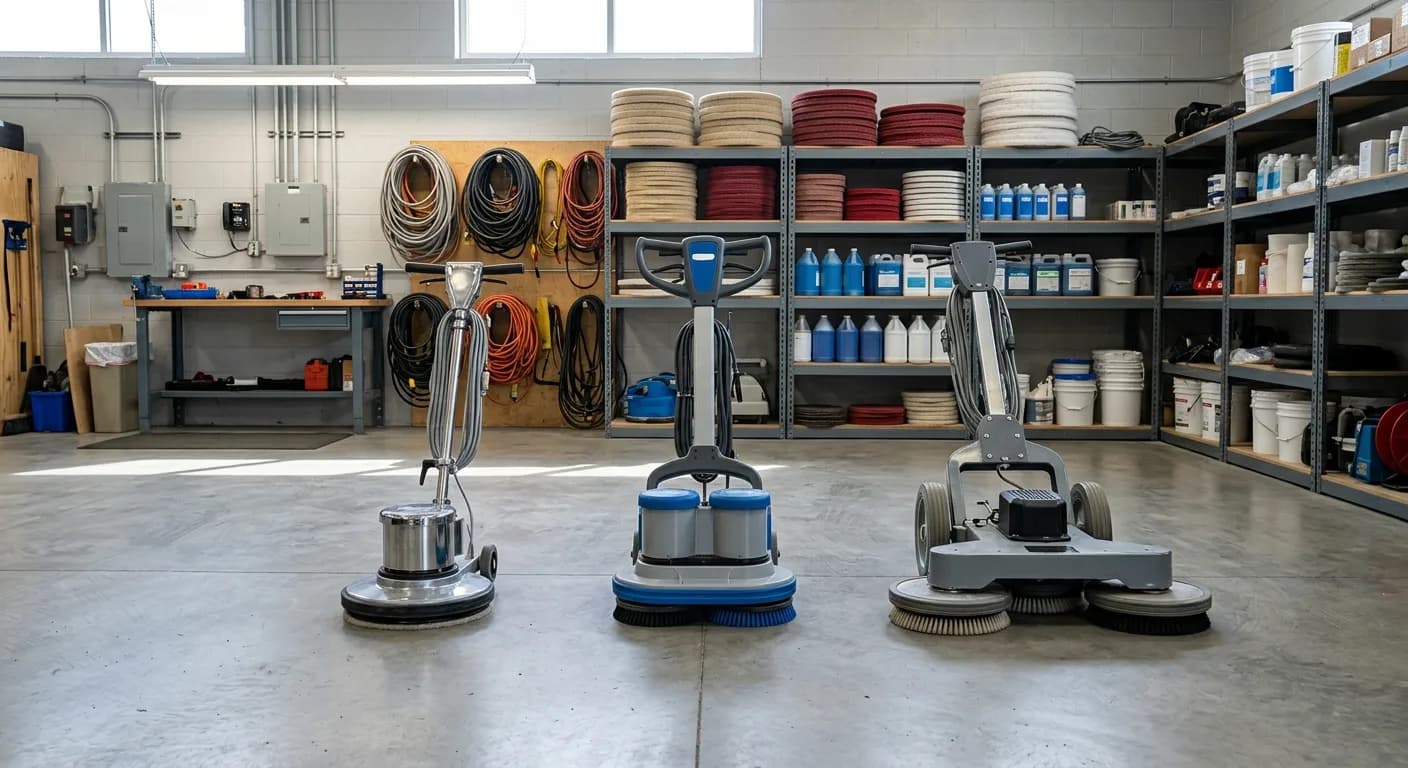
Put our four low-moisture procedure documents side by side and something becomes obvious: they are the same procedure. Pre-vacuum, mix, mist, agitate, dry, vacuum. Six steps, identical wording, identical dry times, identical chemistry.
Exactly one step differs — step four, the agitation. Which is worth knowing, because it means the argument about which machine is "best" is really an argument about which agitation method suits a particular floor, and everything else is settled.
What all four have in common
Every one of them begins with a thorough pre-vacuum, because dry soil is 80 per cent of the total soil in a carpet and adding solution to a carpet full of it makes mud.
Every one mixes encapsulation cleaner to the container directions into a pump-up or electric sprayer, in water of any temperature — though hot water produces noticeably better results.
Every one applies the solution as a mist in a consistent overlapping pattern, with more solution only in heavily soiled areas.
And every one finishes the same way: 20 to 60 minutes to dry to the touch depending on conditions and how much went down, about 24 hours to cure, then the crystallised residue holding the suspended soil is removed by dry vacuuming with high-efficiency collection and filtration. Routine vacuuming keeps lifting crystallised soil afterwards, which is what makes the floor stay clean rather than start declining immediately.
Where they diverge
Bonnet pad
A pre-moistened bonnet pad, flipped when it is heavily soiled so the clean side does the rest. The simplest agitation there is, and the most portable. It works the top of the pile hard and the base of it very little.
Pro Caps
The same bonnet-pad principle on a dedicated machine, which mostly buys consistency: the same pressure over the whole area instead of whatever the operator's arms were doing by the end of a corridor.
Brush Pro
Counter-rotating brushes rather than a pad. The brushes reach deep into the pile, and with stainless renovators fitted the machine removes considerably more dry soil than a commercial vacuum will. This is the one to reach for when the problem is embedded grit rather than surface appearance.
Cimex
Three counter-rotating heads. The counter-rotation is not a marketing detail — it removes the constant slide that a single-direction machine fights you with, so the machine is torqueless and tracks straight over long distances without wearing out the operator. On big open floor plates that is the difference between a clean finished properly and a clean finished quickly.
The Cimex has one more habit worth knowing: it reverses direction each time it is switched on, which stops brushes setting one way and going useless. That applies to brushes, not pads.
How to choose
The floor decides, not the brochure.
- Large open areas — Cimex. Straight tracking and low operator fatigue matter most where there is distance to cover.
- Embedded dry soil in traffic lanes — Brush Pro. Brushes reach where a pad cannot.
- Appearance work on lightly soiled carpet — bonnet or Pro Caps. Fast, low moisture, and enough for what is actually wrong.
- Tight spaces, stairs and small rooms — bonnet, because a three-head machine cannot get in there.
In practice a large building needs more than one. A corridor and a lift lobby have different problems, and the same machine is rarely the right answer for both.
The step that is not on the list
None of these four addresses deeply embedded sand at the base of a heavily trafficked pile. That is a pile lifter's job, done before the clean rather than instead of it — the lifter opens the pile so whatever machine follows can actually reach into it.
Which method suits your floors is part of what a site assessment establishes. See commercial services, or read the low-moisture case at low-moisture carpet cleaning.
Need this handled in your building?
Serving Broward, Miami-Dade and Palm Beach counties.